What Is the Samigo App? Complete Guide
What Is the Smigo App?
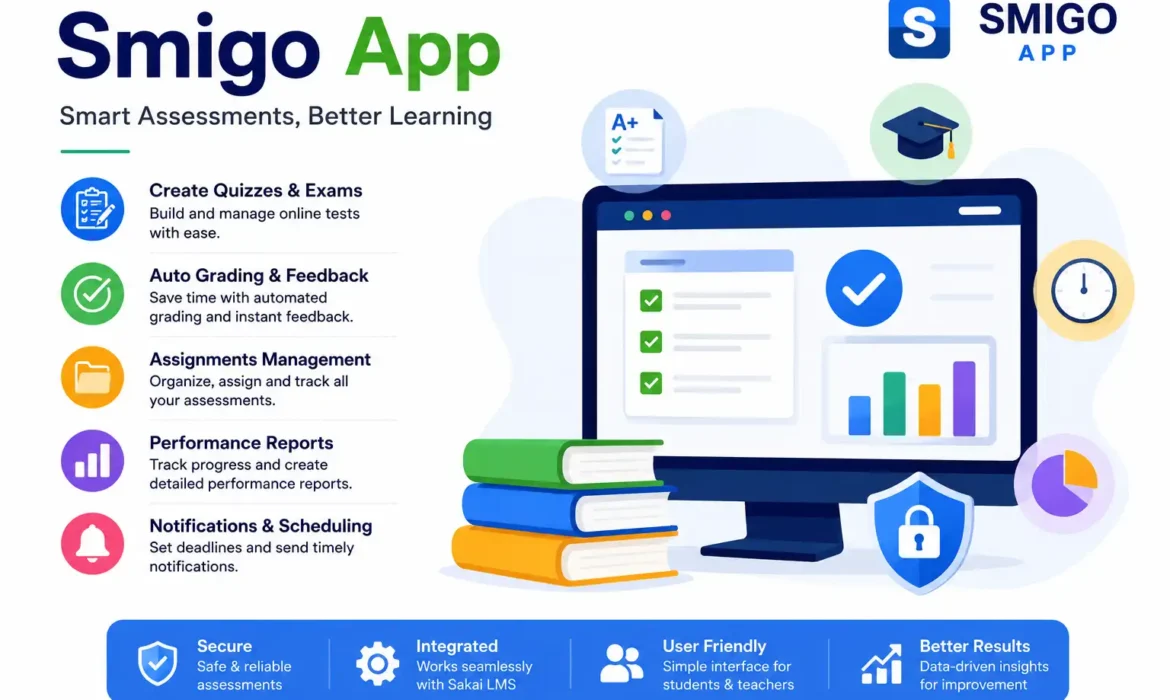
The Smigo App, often associated with Samigo, is an online assessment and testing solution designed for educational institutions using the Sakai Learning Management System (LMS). It helps instructors create quizzes, exams, surveys, and assignments while giving students a secure platform to complete assessments digitally. Instead of relying on paper-based evaluations, educators can manage everything from one dashboard. As e-learning continues to grow worldwide, digital assessment tools like Smigo support faster grading, improved student engagement, and more efficient course management. Its flexible features make it suitable for schools, colleges, universities, and professional training programs.
How Does the Smigo App Work?
The Smigo App functions as an assessment module within the Sakai LMS, allowing educators to design, schedule, and manage online evaluations from a centralized platform. Teachers can create different question formats, assign deadlines, automate grading, and review student performance through detailed reports. Students simply log in using their institution’s credentials to access quizzes, assignments, and exams. The platform stores results securely while integrating grades directly into the course gradebook. This streamlined workflow reduces administrative work and helps educators spend more time improving learning outcomes.
Top Features of the Smigo App
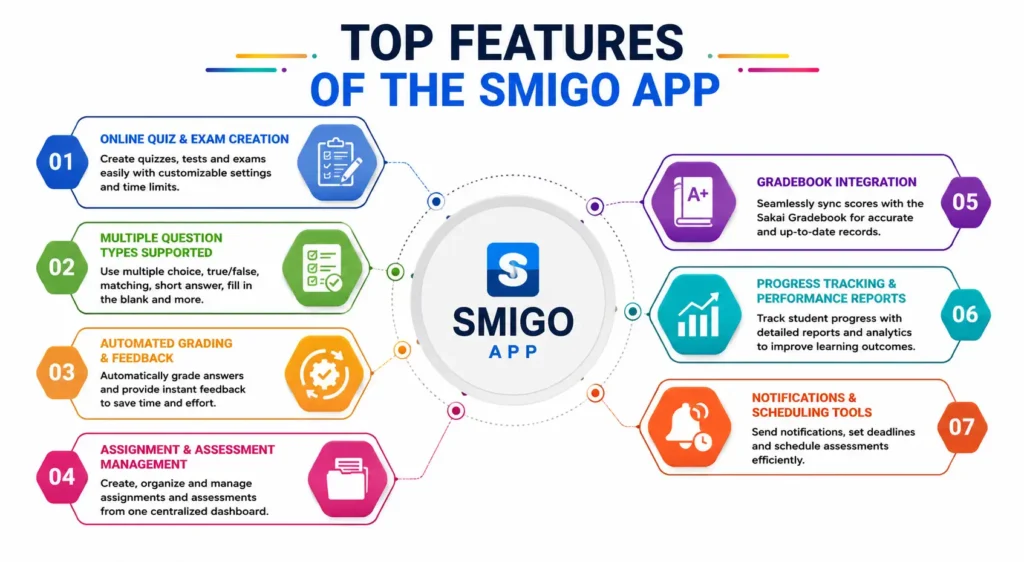
The Smigo App includes a wide range of features that simplify online teaching, learning, and assessment management. From creating quizzes to tracking academic progress, every tool is designed to improve efficiency for both educators and students. The platform combines automation, reporting, secure assessments, and seamless integration with Sakai LMS, making it a practical solution for modern digital classrooms. These features help institutions deliver consistent learning experiences while reducing manual tasks and improving overall academic performance.
Online Quiz and Exam Creation
Smigo enables instructors to create online quizzes, practice tests, and final examinations with customizable settings. Teachers can set time limits, randomize questions, define scoring rules, and schedule availability dates. This flexibility supports fair assessments while reducing administrative effort and ensuring a smooth testing experience for students across different courses.
Automated Grading and Feedback
Automatic grading instantly evaluates objective question types, providing students with quick results and reducing instructor workload. Teachers can also configure personalized feedback, correct answers, and explanations. According to educational research, timely feedback significantly improves learning retention and student performance by helping learners identify and correct mistakes sooner.
Assignment and Assessment Management
Smigo allows educators to organize assignments, quizzes, and exams from a single interface. Teachers can publish assessments, monitor submissions, adjust deadlines, and manage grading without switching between multiple tools. This centralized workflow improves productivity while maintaining consistency across different courses and academic programs.
Gradebook Integration
Assessment scores automatically synchronize with the Sakai Gradebook, eliminating manual grade entry and reducing the risk of errors. Educators can monitor student progress more efficiently, while learners gain immediate access to updated grades, making academic performance tracking transparent and easier to understand.
Progress Tracking and Performance Reports
Smigo provides detailed analytics that help instructors evaluate student participation, quiz scores, completion rates, and overall learning progress. These reports make it easier to identify struggling learners, measure class performance, and make data-driven teaching decisions that improve educational outcomes over time.
Notifications and Scheduling Tools
Built-in scheduling and notification features help instructors announce upcoming quizzes, assignment deadlines, and exam availability. Students receive timely reminders that reduce missed submissions and improve course participation. Organized scheduling also supports better time management for both educators and learners.
Key Benefits of Using the Smigo App
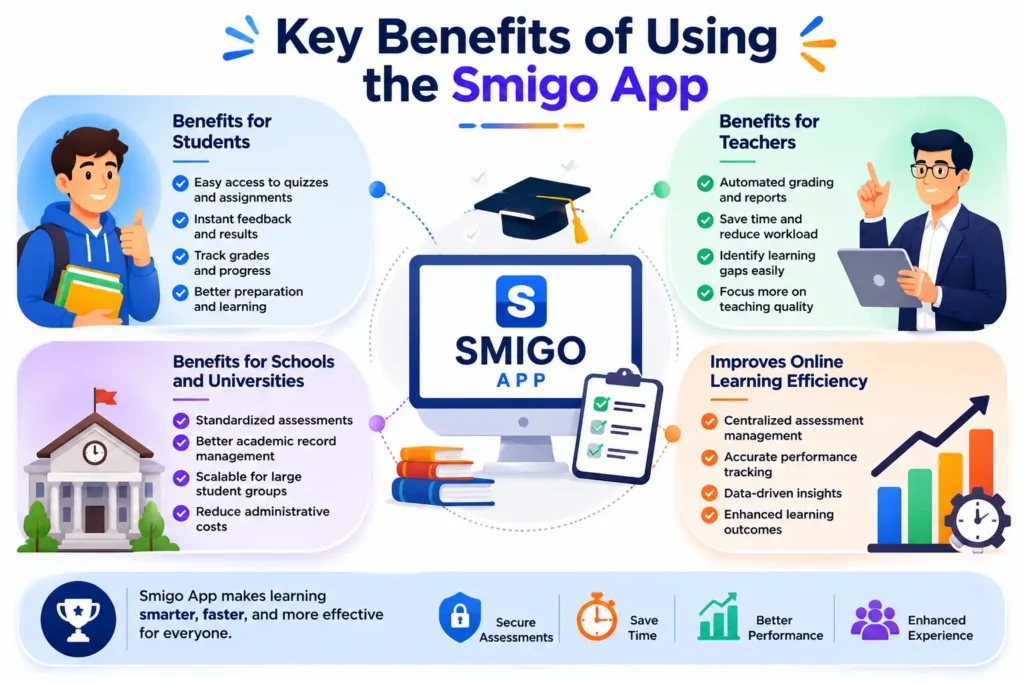
The Smigo App delivers measurable benefits by simplifying assessment management while improving the learning experience. Educators save time through automation, students receive faster feedback, and institutions gain a more organized digital assessment system. Research from the EDUCAUSE Horizon Report highlights that learning analytics and digital assessment technologies help institutions make more informed educational decisions and improve student success. By combining automation, reporting, and secure online testing, Smigo supports modern teaching practices while increasing efficiency, accuracy, and learner engagement across educational environments.
Benefits for Students
Students enjoy a simple interface that makes accessing quizzes, exams, and assignments convenient from any supported device. Instant feedback, organized schedules, and easy grade tracking help learners monitor their academic progress. These features encourage better preparation, increased engagement, and continuous improvement throughout each course.
Benefits for Teachers and Instructors
Teachers reduce repetitive administrative work through automated grading, centralized assessment management, and integrated reporting tools. They can focus more on teaching quality, curriculum improvement, and personalized student support instead of manual grading. Performance analytics also help instructors identify learning gaps more effectively.
Benefits for Schools and Universities
Educational institutions benefit from standardized assessments, improved academic record management, and scalable digital learning infrastructure. Smigo supports consistent evaluation processes while reducing paperwork and administrative costs. Centralized reporting also helps departments monitor academic performance and maintain institutional quality standards more efficiently.
How It Improves Online Learning Efficiency
Smigo improves online learning by combining assessments, grading, reporting, and scheduling within a unified platform. Students spend less time navigating multiple systems, while instructors manage courses more efficiently. Research from UNESCO has consistently emphasized that well-designed digital learning environments enhance accessibility, flexibility, and educational continuity across diverse learning settings.
🌟 Recommended for You: How to Start a Marketing Agency in 2026 | Best Guide
Smigo App Use Cases
The Smigo App is designed to support a variety of educational and training scenarios, making it more than just an online testing platform. Whether it’s conducting classroom quizzes, managing assignments, or delivering remote learning assessments, the platform helps organizations streamline evaluation processes. Its integration with the Sakai Learning Management System makes it especially valuable for universities and institutions that require secure, scalable, and data-driven assessment solutions. From higher education to corporate training, Smigo enables instructors and administrators to deliver consistent learning experiences while improving productivity and learner engagement.
Online Exams and Quizzes
Smigo allows educators to create secure online exams, practice tests, and timed quizzes for any subject. Features like question randomization, automatic grading, and controlled availability help reduce academic dishonesty while simplifying exam management. Students can complete assessments digitally, making the testing process faster and more convenient.
Classroom Assessments
Teachers can use Smigo to conduct regular classroom assessments without relying on paper-based tests. Short quizzes, weekly evaluations, and formative assessments help instructors measure student understanding throughout the course. Immediate scoring and performance reports enable faster instructional adjustments and continuous academic improvement.
Distance and Remote Learning
As online education continues to expand, Smigo supports remote learning by providing a secure environment for digital assessments. Students can complete quizzes and assignments from virtually any location while instructors monitor participation and performance. This flexibility helps institutions maintain educational continuity regardless of physical classroom access.
Homework and Assignment Management
Smigo simplifies homework distribution and assignment tracking through a centralized dashboard. Educators can publish tasks, set submission deadlines, review completed work, and provide feedback without using multiple platforms. Students benefit from organized schedules, making it easier to manage coursework and meet academic deadlines.
Employee and Training Assessments
Beyond education, organizations can use Smigo to evaluate employee knowledge during onboarding, compliance programs, and professional development courses. Trainers can create certification exams, monitor learning progress, and generate performance reports. This makes the platform suitable for structured workplace learning and skills development initiatives.
Smigo App Pros and Cons
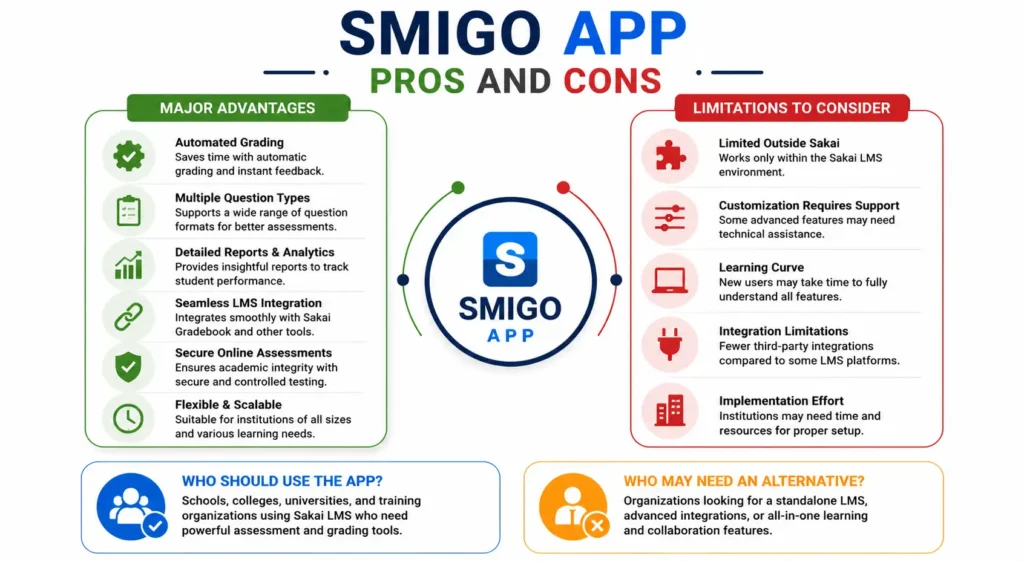
Like any learning management solution, the Smigo App offers strengths and limitations depending on an organization’s needs. Its assessment-focused design, automation, and Sakai integration provide significant value for educational institutions. However, users should also consider technical requirements, institutional support, and compatibility before implementation. Evaluating both the advantages and drawbacks helps educators choose the right platform for their teaching environment while ensuring it aligns with their learning objectives, infrastructure, and long-term digital education strategy.
Major Advantages
Smigo offers automated grading, multiple assessment formats, detailed reporting, and seamless Sakai Gradebook integration. These features reduce instructor workload while improving assessment accuracy. The platform also supports secure online testing, flexible scheduling, and scalable course management, making it suitable for institutions of different sizes.
Limitations to Consider
Smigo primarily serves organizations using the Sakai Learning Management System, limiting accessibility for users outside that ecosystem. Some advanced customization features may require administrator support or technical knowledge. Institutions already using another LMS may face migration challenges during implementation.
Who Should Use the App?
Smigo is best suited for universities, colleges, schools, training centers, and organizations that rely on Sakai for online learning. Instructors managing frequent assessments, certification programs, or large student groups can benefit from its automation, reporting capabilities, and efficient assessment management tools.
Who May Need an Alternative?
Organizations that require standalone learning platforms, advanced collaboration features, or broader third-party integrations may prefer alternatives. Businesses seeking comprehensive employee learning management beyond assessment delivery might also evaluate other LMS platforms that offer expanded content management and communication features.
🌟 Recommended for You: How to Keep Your Blog Updated for Better SEO
Smigo App vs Other Learning Management Systems
Choosing the right learning management system depends on institutional goals, teaching methods, and technical requirements. While Smigo focuses heavily on assessment management within Sakai, other platforms provide different strengths in course delivery, collaboration, and content management. Understanding these differences helps educators select a solution that matches their instructional needs. The comparison below highlights how Smigo performs against several of the most widely used learning management systems in education today.
Smigo App vs Moodle
Both Smigo and Moodle support online assessments, but they serve different purposes. Smigo functions as an assessment tool within Sakai, whereas Moodle is a complete open-source learning management system. Moodle provides broader course management capabilities, while Smigo delivers a streamlined assessment experience for Sakai users.
Smigo App vs Canvas LMS
Canvas LMS offers modern course management, multimedia learning, and extensive third-party integrations. Smigo focuses more specifically on assessment creation and grading inside the Sakai ecosystem. Institutions already using Sakai may find Smigo more practical, while Canvas is often preferred for its broader learning environment.
Smigo App vs Google Classroom
Google Classroom emphasizes assignment sharing, communication, and collaboration using Google Workspace. Smigo provides more advanced testing capabilities, including question randomization, secure assessments, automated grading, and detailed reporting. Educational institutions requiring structured examinations often need features beyond Google Classroom’s assessment tools.
Which Platform Is Better for Online Assessments?
The best platform depends on your institution’s infrastructure and learning objectives. For organizations already using Sakai, Smigo provides excellent assessment management through seamless integration and automated workflows. Institutions seeking a complete learning management ecosystem may prefer Moodle or Canvas, while schools focused on simple classroom collaboration often choose Google Classroom. Selecting the right platform ultimately depends on assessment complexity, scalability, budget, and existing educational technology.
🌟 Recommended for You: How to Choose a Website for Backlinks (SEO Guide)
How to Get Started with the Smigo App
Getting started with the Smigo App is straightforward for institutions using the Sakai Learning Management System. Since Smigo functions as an integrated assessment tool rather than a standalone application, users typically receive access through their school, university, or organization’s learning portal. After logging in, instructors can create assessments, manage grades, and monitor student performance, while learners can access quizzes and assignments from a centralized dashboard. Following a few simple steps helps users take full advantage of the platform’s assessment and learning management capabilities.
How to Access the Platform
Users access Smigo through their institution’s Sakai LMS portal using a web browser. After signing in with assigned credentials, they can navigate to the course dashboard where quizzes, assignments, and assessments are available. Access permissions depend on the user’s role, such as student, instructor, or administrator.
Login Requirements
To use Smigo, users generally need an active institutional account provided by their school, university, or organization. Login credentials are managed by the institution’s IT or LMS administrator. Since Smigo is integrated with Sakai, separate account registration is usually unnecessary for authorized users.
Creating Your First Assessment
Instructors can create an assessment by selecting the assessment tool within Sakai, adding questions, configuring grading options, setting time limits, and publishing the quiz. Smigo supports multiple question formats and scheduling features, allowing educators to build assessments that match their teaching objectives and course requirements.
Tips for Students Taking Online Tests
Students should review assessment instructions carefully, ensure a stable internet connection, and use a compatible web browser before beginning an online test. Logging in early, avoiding distractions, and checking submission confirmations can help prevent technical issues while improving the overall testing experience.
Best Practices for Teachers
Teachers should organize assessments with clear instructions, balanced question types, and realistic time limits. Using randomized questions, automated feedback, and performance reports helps improve assessment quality while supporting academic integrity. Reviewing analytics after each assessment also helps identify learning gaps and improve future instruction.
Frequently Asked Questions
What is the Smigo (Samigo) App used for?
The Smigo App is primarily used to create, manage, and evaluate online quizzes, exams, surveys, and assignments within the Sakai Learning Management System.
Is Smigo a standalone mobile app?
No. Smigo is generally recognized as the assessment component of the Sakai Learning Management System rather than a standalone consumer mobile application. Users typically access it through their institution’s Sakai portal using a supported web browser.
Can anyone use the Smigo App?
Access is usually limited to students, instructors, and staff whose educational institution or organization uses the Sakai LMS. Individual users cannot typically create independent accounts without authorization from the institution managing the learning platform.
Is the Smigo App free?
For students and instructors, access is generally included through their institution’s Sakai implementation. Educational organizations may incur costs related to hosting, maintenance, customization, or technical support, depending on how their Sakai environment is managed.
Which devices support the Smigo App?
Smigo works on most modern desktops, laptops, tablets, and smartphones through compatible web browsers. Since it operates within the Sakai LMS, users can access assessments from Windows, macOS, ChromeOS, Android, and iOS devices with internet connectivity.
Is the Smigo App available on Android or iPhone?
There is no widely distributed standalone Smigo application available on Google Play or the Apple App Store. Mobile users generally access the platform through their institution’s Sakai website using a mobile browser or supported institutional application.
How secure are online exams in Smigo?
Smigo includes several security features such as authentication, timed assessments, question randomization, controlled availability, and secure grade management. Institutions may also implement additional security measures depending on their Sakai configuration and academic integrity policies.
What types of questions can instructors create?
Instructors can create multiple-choice, true or false, matching, fill-in-the-blank, short answer, essay, and other assessment question types. This flexibility enables educators to evaluate factual knowledge, critical thinking, problem-solving, and written communication skills effectively.
Does Smigo integrate with other educational tools?
Yes. Smigo integrates directly with the Sakai Learning Management System and works alongside course management features such as Gradebook, Assignments, Announcements, and user management. Available integrations may vary depending on the institution’s Sakai implementation and installed plugins.
Is the Smigo App suitable for businesses or only educational institutions?
Although primarily designed for educational institutions, Smigo can also support employee training, certification programs, compliance assessments, and professional development. Organizations using Sakai for workplace learning can leverage its assessment features to evaluate employee knowledge and track training progress efficiently.
Introduction
Online learning has transformed the way educational institutions deliver courses, evaluate student performance, and manage academic assessments. As digital education continues to expand, reliable assessment platforms have become essential for maintaining efficiency and academic integrity. The Smigo App, commonly associated with Samigo in the Sakai Learning Management System, is one such solution that helps educators create online quizzes, exams, assignments, and surveys while simplifying grading and performance tracking. In this comprehensive guide, you’ll learn what the Smigo App is, how it works, its key features, benefits, practical use cases, comparisons with other learning management systems, and whether it’s the right assessment platform for your educational or training needs.
🔗 More Good Ones Are Coming. Follow True Linkers.

How to Start a Marketing Agency in 2026 | Best Guide
How to Start a Marketing Agency in 2026 | Best Guide
Starting a marketing agency in 2026 is one of the most practical ways to build a profitable online business. As companies continue investing in digital growth, they need experts who can generate leads, improve search rankings, manage paid advertising, and create engaging content. At the same time, artificial intelligence has made agency operations faster and more efficient, allowing even small teams to compete with larger firms.
According to industry research from Statista, global digital advertising spending is expected to continue growing throughout 2026, while businesses are increasingly outsourcing specialized marketing tasks instead of hiring large in-house teams. This creates significant opportunities for freelancers, consultants, and entrepreneurs who want to launch their own agencies.
This step-by-step guide explains everything beginners need to know, from choosing the right niche and creating a business plan to setting up a legal business, building a professional brand, and pricing services confidently.
Choose Your Marketing Agency Niche and Services
One of the biggest mistakes new agency owners make is trying to serve everyone. Instead, choose a niche where you can become an expert and build authority faster. You might specialize in SEO, PPC advertising, content marketing, email marketing, social media management, or AI automation. You can also focus on industries such as healthcare, real estate, SaaS, law firms, or ecommerce. A specialized agency communicates a clearer value proposition, attracts better-qualified leads, and often commands higher pricing. Once your niche is defined, create service packages that solve measurable business problems rather than simply offering marketing tasks.
Build a Business Plan for Your Marketing Agency
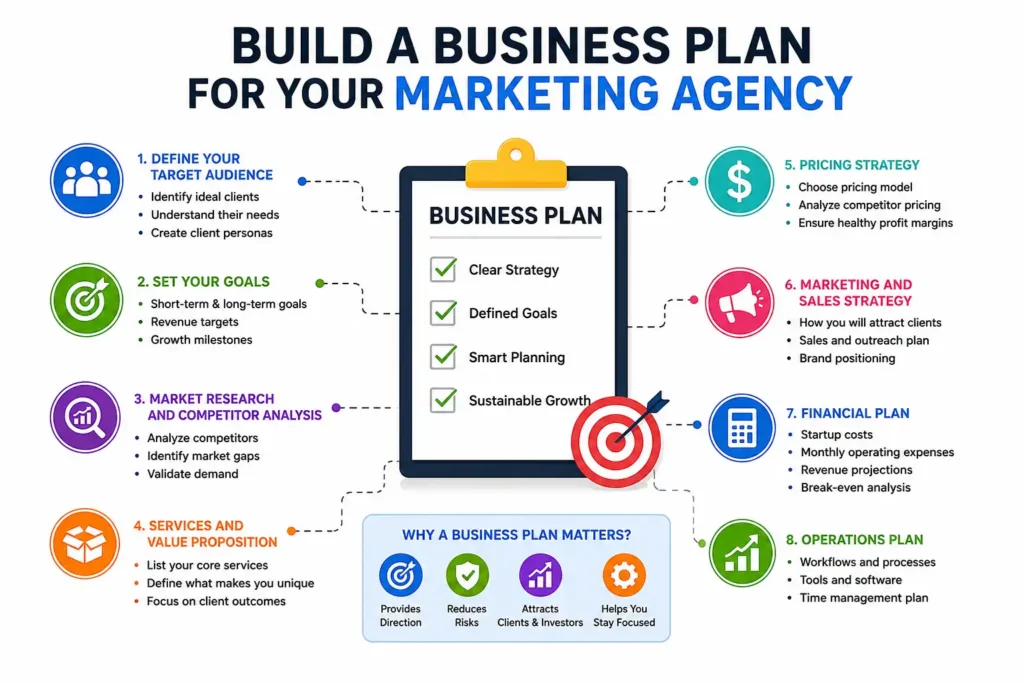
A well-structured business plan gives your agency direction and improves long-term decision-making. Define your target audience, competitive advantages, pricing strategy, revenue goals, marketing channels, and projected expenses before launching. Include realistic financial estimates for software subscriptions, advertising, taxes, and operational costs. Research competitors to identify market gaps you can fill with unique positioning.
According to the U.S. Small Business Administration, businesses that plan carefully are generally better prepared for growth and unexpected challenges. Treat your business plan as a living document that evolves alongside your agency instead of a one-time exercise.
Register Your Marketing Agency and Set Up the Business
Registering your marketing agency establishes credibility and protects your business legally. Choose the appropriate business structure based on your country’s regulations, such as an LLC, sole proprietorship, or corporation. Obtain required tax registrations, business licenses, and banking accounts before signing clients.
Separate personal and business finances to simplify accounting and tax reporting. Use professional accounting software to track income, expenses, and invoices accurately from day one. Having legally compliant contracts, clear payment terms, and privacy policies also helps prevent disputes while creating trust with clients and business partners.
📌 Don’t Miss These Articles: How to Keep Your Blog Updated for Better SEO
Create Your Brand, Website, and Online Presence
Your agency’s online presence acts as your strongest sales representative, so invest in building a professional brand from the beginning. Develop a memorable business name, consistent logo, color palette, and messaging that reflect your niche. Your website should clearly explain your services, showcase case studies, display testimonials, and include strong calls to action.
Optimize every page for SEO using relevant keywords and a fast-loading design. Maintain active profiles on LinkedIn and other platforms where your target audience spends time. Publishing educational content consistently helps establish credibility, improve search visibility, and attract qualified inbound leads.
Decide Your Pricing Model and Agency Packages
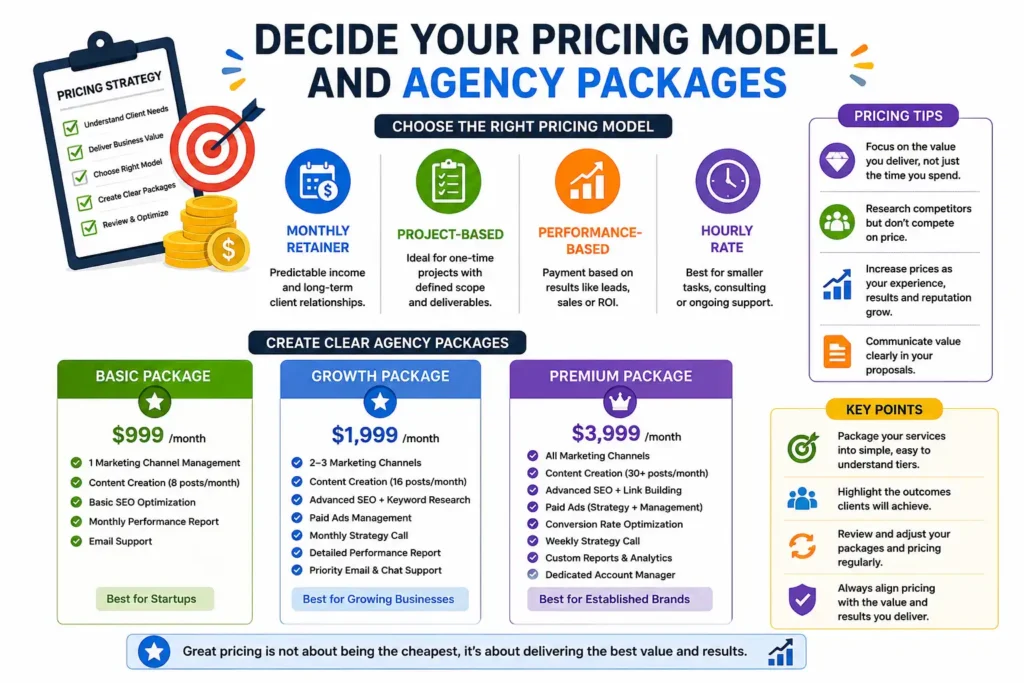
Choosing the right pricing model directly impacts your profitability and client relationships. Most successful agencies use monthly retainers because they provide predictable recurring revenue and encourage long-term partnerships. Project-based pricing works well for website development or one-time SEO audits, while performance-based pricing can suit lead generation campaigns with measurable outcomes.
Package your services into clear tiers instead of offering endless custom quotes. Explain the business value clients receive rather than focusing only on deliverables. Review your pricing regularly as your expertise, reputation, and client results continue to grow over time.
Get Your First Clients and Build a Strong Reputation
Getting your first clients is often the hardest part of starting a marketing agency, but it becomes easier with a focused strategy. Begin by leveraging your existing network, LinkedIn connections, local businesses, and freelance platforms. Offer free or discounted pilot projects to build case studies and collect testimonials. Publish valuable content that demonstrates your expertise and answers common marketing questions.
According to HubSpot’s State of Marketing research, businesses increasingly prefer agencies that showcase measurable results and industry knowledge. Deliver outstanding customer service, communicate consistently, and exceed expectations to earn referrals that fuel long-term agency growth.
📌 Don’t Miss These Articles: How to Choose a Website for Backlinks (SEO Guide)
Build the Right Team and Scale Your Agency
As your client base grows, building the right team becomes essential for maintaining quality and increasing profitability. Start by outsourcing specialized tasks such as graphic design, copywriting, web development, or video editing before hiring full-time employees. Create documented workflows and standard operating procedures to ensure consistent service delivery.
Invest in training and encourage collaboration through modern communication platforms. Successful agencies focus on improving systems rather than simply adding more people. By automating repetitive work, delegating responsibilities, and tracking key performance indicators, you can scale efficiently while maintaining exceptional client satisfaction and healthy profit margins.
Best AI Tools and Marketing Software for Agencies in 2026
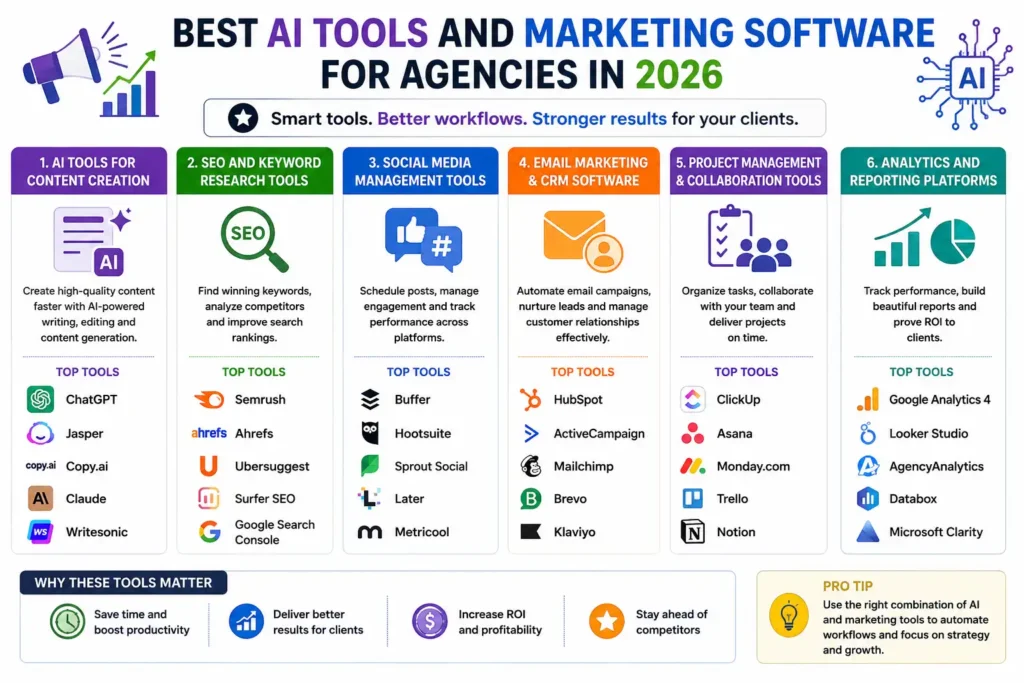
Modern marketing agencies rely heavily on artificial intelligence and automation to improve productivity, reduce operational costs, and deliver better client results. The right software can streamline content creation, keyword research, project management, reporting, customer communication, and campaign optimization.
According to McKinsey research, organizations adopting AI effectively are achieving significant productivity improvements across knowledge-based work. Instead of using dozens of disconnected platforms, choose tools that integrate well with your workflow. Below are some of the most valuable AI-powered marketing tools every agency should consider using in 2026.
AI Tools for Content Creation
AI-powered content tools help agencies create high-quality blogs, ad copy, email campaigns, landing pages, and social media posts much faster than traditional methods. Popular platforms like ChatGPT, Claude, Jasper, and Copy.ai assist with brainstorming, writing, editing, and content optimization while maintaining brand consistency. Human editing remains essential for originality, fact-checking, and maintaining a unique voice. Agencies that combine AI efficiency with professional expertise consistently produce better results.
SEO and Keyword Research Tools
Strong SEO campaigns begin with reliable keyword and competitor research. Tools such as Ahrefs, Semrush, Google Search Console, Surfer SEO, and Keyword Insights help agencies discover search opportunities, analyze backlinks, monitor rankings, and optimize content. These platforms also identify technical SEO issues and content gaps that competitors have not addressed. Using accurate search data enables agencies to create strategies based on real user demand instead of assumptions.
Social Media Management Tools
Managing multiple client accounts manually wastes valuable time. Platforms like Buffer, Hootsuite, Sprout Social, Metricool, and Later simplify scheduling, content planning, engagement tracking, and performance reporting across major social networks. Many now include AI-powered caption generation, hashtag suggestions, and optimal posting time recommendations. Centralizing social media management allows agencies to improve consistency while saving hours every week.
Email Marketing and CRM Software
Email marketing remains one of the highest ROI digital marketing channels. According to Litmus research, email marketing continues delivering exceptional returns for many businesses when executed strategically. Platforms like HubSpot, ActiveCampaign, Mailchimp, Brevo, and Klaviyo help agencies automate campaigns, segment audiences, nurture leads, and manage customer relationships. Combining CRM data with marketing automation creates highly personalized customer experiences that improve conversions and long-term retention.
Project Management and Collaboration Tools
Efficient project management keeps agency operations organized and clients satisfied. Platforms such as ClickUp, Asana, Monday.com, Trello, and Notion allow teams to assign tasks, monitor deadlines, share files, and collaborate in real time. Integrating communication tools like Slack further improves productivity and reduces unnecessary meetings. Clear workflows minimize mistakes, improve accountability, and help agencies deliver projects on schedule.
Analytics and Reporting Platforms
Clients expect transparent reporting that demonstrates measurable business impact. Google Analytics 4, Looker Studio, AgencyAnalytics, Databox, and Microsoft Clarity help agencies measure website performance, understand visitor behavior, monitor marketing campaigns, and track conversion data through detailed analytics and reporting. Automated dashboards reduce manual reporting while helping agencies explain ROI clearly. Data-driven reporting also supports better strategic decisions and strengthens long-term client relationships by highlighting continuous performance improvements.
Don’t Make These Mistakes When Starting a Marketing Agency
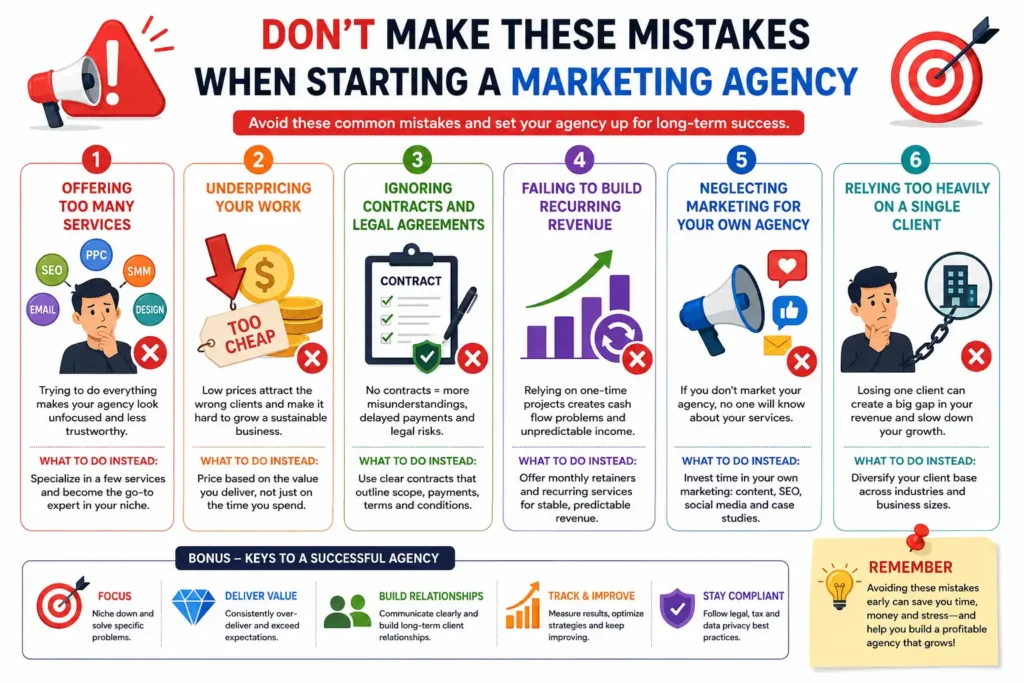
Many marketing agencies fail because of avoidable mistakes rather than a lack of demand. Poor positioning, weak financial planning, inconsistent service quality, and ineffective client management can limit long-term growth. Learning from common agency failures helps you avoid costly setbacks and build a stronger business foundation. Focus on sustainable systems instead of chasing quick wins. By maintaining realistic pricing, specializing in your expertise, and delivering consistent results, you can establish a profitable agency that earns client trust and grows steadily in an increasingly competitive digital marketplace.
Offering Too Many Services
Trying to provide every marketing service often confuses potential clients and weakens your positioning. Instead, specialize in a few high-value services where your team delivers exceptional results. A focused agency builds authority faster, simplifies operations, and attracts better-qualified leads looking for specific expertise rather than general marketing assistance.
Underpricing Your Work
Many beginners charge extremely low prices just to win clients, but this often attracts difficult customers and reduces profitability. Price your services based on the value you deliver instead of competing solely on cost. Sustainable pricing allows you to invest in better tools, talented professionals, and long-term business growth.
Ignoring Contracts and Legal Agreements
Never begin client work without a professionally written contract. Clearly define project scope, payment schedules, ownership rights, revision limits, confidentiality, and termination clauses. Strong agreements protect both parties, reduce misunderstandings, and create a professional client experience that strengthens trust from the beginning of every engagement.
Failing to Build Recurring Revenue
Depending only on one-time projects creates inconsistent cash flow and limits long-term growth. Instead, develop monthly retainers for SEO, content marketing, social media management, or paid advertising. Recurring revenue provides financial stability, improves client retention, and allows you to forecast future business performance more accurately.
Neglecting Marketing for Your Own Agency
Many agency owners spend all their time marketing clients while ignoring their own business. Consistently publish helpful content, improve your website’s SEO, share case studies, and stay active on LinkedIn. Demonstrating your own marketing success builds credibility and generates qualified inbound leads without relying entirely on referrals.
Relying Too Heavily on a Single Client
Depending on one large client creates unnecessary business risk. If that client leaves, your revenue can drop dramatically overnight. Diversify your client portfolio across multiple industries and business sizes to create stable income. A balanced client base protects your agency during economic changes and unexpected contract cancellations.
Frequently Asked Questions
How much money do I need to start a marketing agency?
You can start a marketing agency with as little as $500 to $3,000, depending on your business model and the services you offer. Your initial expenses typically include a domain name, website hosting, branding, business registration, essential software, and marketing tools. If you work remotely and use AI-powered platforms, startup costs remain relatively low. Many successful agency owners begin as solo freelancers before reinvesting profits into hiring team members and expanding their operations.
Can I start a marketing agency with no experience?
Yes, but you should first develop practical marketing skills before accepting paying clients. Learn through online courses, certifications, personal projects, internships, or freelance work. Build a portfolio by helping local businesses or nonprofit organizations achieve measurable results. Certifications from Google, HubSpot, and Meta can strengthen your credibility. The more real-world experience and case studies you have, the easier it becomes to attract clients and establish trust in a competitive marketplace.
Which marketing services are most profitable in 2026?
In 2026, some of the highest-profit marketing services include SEO, paid advertising (PPC), AI automation consulting, conversion rate optimization, content marketing, email marketing, social media advertising, and marketing strategy consulting. These services often generate recurring monthly revenue while delivering measurable business results. Agencies specializing in high-demand industries such as SaaS, healthcare, finance, and ecommerce can often charge premium rates because clients place significant value on proven expertise and measurable growth.
How do marketing agencies get their first clients?
Most agencies secure their first clients through personal networks, LinkedIn outreach, referrals, local business communities, and freelance marketplaces. Publishing valuable content, sharing case studies, and offering free consultations also help build credibility. Cold email campaigns and strategic partnerships with web developers or business consultants can generate qualified leads. Providing outstanding service to early clients often results in testimonials and referrals, creating a steady pipeline of new business opportunities.
How long does it take to become profitable?
The timeline depends on your pricing, expenses, marketing strategy, and client acquisition efforts. Many solo agency owners become profitable within three to twelve months if they consistently attract recurring clients and manage expenses carefully. Agencies focused on monthly retainers generally achieve more predictable revenue than those relying solely on one-time projects. Consistency, strong client relationships, and efficient operations are the biggest factors influencing long-term profitability.
Should I start alone or with a team?
Starting alone is often the smartest option because it keeps costs low and allows you to understand every part of your business. As your workload increases, outsource specialized tasks such as design, development, or video editing before hiring full-time employees. This flexible approach reduces financial risk while allowing your agency to grow naturally. Build a permanent team only when consistent client demand supports sustainable long-term expansion.
Is starting a marketing agency still worth it in 2026?
Yes. Demand for digital marketing continues to increase as businesses compete online and adopt AI-driven strategies. Companies still need experienced professionals to manage SEO, advertising, content creation, analytics, and customer acquisition. While competition has grown, agencies that specialize in a specific niche, deliver measurable results, and leverage AI effectively continue to build profitable businesses. Success depends more on expertise, positioning, and execution than simply entering the market early.
What skills are essential to run a successful marketing agency?
A successful agency owner needs a combination of marketing expertise and business management skills. Core abilities include SEO, paid advertising, content marketing, analytics, communication, sales, client relationship management, project management, and financial planning. Leadership, problem-solving, and adaptability are equally important as marketing trends continue evolving. Learning how to use AI tools effectively is now becoming a competitive advantage for agencies serving modern businesses.
Can I run a marketing agency remotely?
Absolutely. Modern cloud-based software allows agencies to operate entirely online while serving clients worldwide. Video conferencing, project management platforms, file-sharing systems, and digital payment solutions make remote collaboration simple and efficient. Many successful agencies have fully distributed teams working across different countries and time zones. Operating remotely also reduces overhead costs while giving you access to a larger talent pool and broader client opportunities.
Which AI tools should every new marketing agency use?
Every new marketing agency should consider using AI tools that improve productivity without sacrificing quality. Popular options include ChatGPT and Claude for content creation, Semrush or Ahrefs for SEO research, Canva AI for design, HubSpot AI for CRM and marketing automation, ClickUp AI for project management, and Google Analytics 4 for performance tracking. Choosing integrated tools helps streamline workflows, save time, and deliver better client outcomes with fewer manual tasks.
Conclusion
Starting a marketing agency in 2026 offers tremendous opportunities for entrepreneurs willing to develop valuable skills and build a client-focused business. Success doesn’t require a large office or a massive investment. Instead, it depends on choosing the right niche, creating clear service packages, using modern AI tools, delivering measurable results, and building long-term client relationships.
Focus on continuous learning, maintain high service standards, and adapt to changing marketing trends. With patience, consistency, and a growth mindset, your marketing agency can evolve into a profitable and scalable business that serves clients around the world.
💡 Learn what really works in modern SEO. Follow True Linkers.
How to Keep Your Blog Updated for Better SEO
Why Keeping Your Blog Updated Matters
Publishing a blog post is only the beginning. Search engines and readers both expect content to stay accurate, relevant, and helpful over time. Updating your blog improves content quality, fixes outdated information, and aligns your pages with current search intent. According to Google, its ranking systems prioritize content that demonstrates experience, expertise, authoritativeness, and trustworthiness (E-E-A-T), making freshness important when topics change. Regular updates can also improve click-through rates, reduce bounce rates, and increase organic visibility. A well-maintained blog builds credibility, keeps visitors engaged longer, and creates more opportunities to earn backlinks and higher search rankings.
5 Best Tips to Keep Your Blog Updated
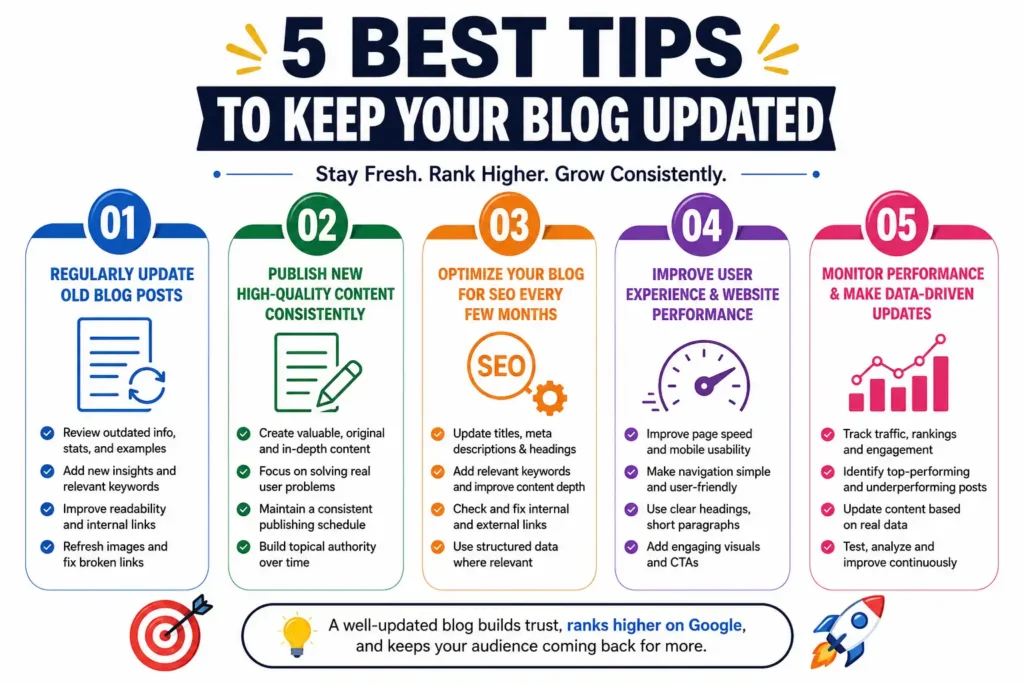
Tip #1: Regularly Update Old Blog Posts
One of the fastest ways to grow organic traffic is by refreshing existing content instead of constantly creating new articles. Review older posts after every 6 to 12 months and update new statistics, fix broken links, screenshots, examples, and recommendations. Add newly discovered keywords, answer emerging search queries, and improve readability with clearer formatting. Research from multiple SEO industry studies has shown that refreshed content often regains lost rankings and attracts new visitors. Keeping evergreen articles current signals reliability to readers while helping search engines understand that your content continues to provide accurate and valuable information.
Tip #2: Publish New High-Quality Content Consistently
Updating old content is essential, but publishing fresh, valuable articles remains equally important for long-term growth. Consistency helps search engines crawl your website more frequently while giving readers new reasons to return. Focus on solving real problems instead of chasing every trending keyword. Build topical authority by covering related subjects in depth and linking articles together naturally. Original research, expert insights, case studies, and practical examples make your content stand out. A realistic publishing schedule that prioritizes quality over quantity delivers better SEO results than posting low-value articles simply to maintain frequency.
Tip #3: Optimize Your Blog for SEO Every Few Months
SEO is constantly evolving, so regular optimization keeps your blog competitive. Every few months, review title tags, meta descriptions, internal links, image alt text, heading structure, and keyword placement. Check whether search intent has changed and expand sections that competitors cover more effectively. Google’s Helpful Content guidance encourages content created primarily for people rather than search engines, making user satisfaction a critical ranking factor. Refresh structured data where appropriate, improve content depth, and remove unnecessary keyword repetition. These small improvements can significantly increase search visibility without requiring a completely new article.
Tip #4: Improve User Experience and Website Performance
Even exceptional content can lose rankings if visitors have a poor experience. Improve page loading speed, simplify navigation, optimize images, and ensure your website works perfectly on mobile devices. Google continues to emphasize page experience alongside content quality because users expect fast, accessible websites. Clear typography, logical headings, shorter paragraphs, and visible calls-to-action help readers stay engaged longer. Regularly test for broken links, layout issues, and slow-loading elements. A faster, user-friendly blog increases engagement, encourages repeat visits, reduces bounce rates, and supports stronger long-term SEO performance.
Tip #5: Monitor Performance and Make Data-Driven Updates
Successful bloggers rely on data instead of assumptions when improving their content. Monitor metrics such as organic traffic, keyword rankings, click-through rates, average engagement time, and conversions to identify pages needing attention. Use performance reports to discover declining articles, new keyword opportunities, and pages with high impressions but low clicks. Update those posts with stronger headlines, improved introductions, clearer answers, and additional value. Making informed decisions based on real user behavior allows you to prioritize high-impact updates, maximize existing content, and achieve sustainable organic growth over time.
🎯 More Helpful Guides: How to Choose a Website for Backlinks (SEO Guide)
Additional Best Practices to Keep Your Blog Fresh
Beyond updating content and publishing consistently, a few extra habits can significantly improve your blog’s long-term performance. Small improvements made regularly often produce better results than major overhauls once every few years. Refreshing visuals, expanding FAQs, repurposing content, and optimizing calls-to-action all help keep your blog engaging and relevant. These updates also improve user experience, increase time on page, and encourage conversions. Google’s helpful content systems reward pages that continue providing value, making ongoing improvements an important part of any successful content marketing and SEO strategy.
Add New Visuals, Infographics, and Videos
Visual content makes blog posts easier to understand and more enjoyable to read. Replace outdated screenshots, add custom graphics, include comparison tables, or embed short explainer videos where appropriate. Research from Wyzowl consistently shows that people prefer learning through video, while informative visuals improve engagement and readability. Fresh media also increases the likelihood of earning backlinks and social shares, keeping your content competitive.
Update FAQs Based on User Questions
Your audience constantly asks new questions through search engines, comments, emails, and social media. Review these questions regularly and expand your FAQ section with clear, direct answers. Adding relevant FAQs helps satisfy search intent, improves topical completeness, and can increase your chances of appearing in Google’s rich results. Updated FAQs also reduce user confusion and build trust by addressing real concerns.
Repurpose Blog Content Into Multiple Formats
One high-quality article can become several valuable content assets. Turn blog posts into videos, infographics, email newsletters, LinkedIn posts, social media carousels, podcasts, or downloadable checklists. Repurposing extends your content’s lifespan while reaching audiences who prefer different formats. It also strengthens brand visibility and drives additional traffic back to your original article without creating entirely new content from scratch.
Refresh Calls-to-Action to Improve Conversions
Your call-to-action should evolve as your business goals and audience needs change. Replace outdated offers, improve button copy, update internal links, and highlight your latest products or services. Test different CTA placements and messaging to improve click-through and conversion rates. A relevant, compelling CTA encourages readers to take the next step instead of leaving your website after finishing the article.
Common Mistakes That Make a Blog Outdated
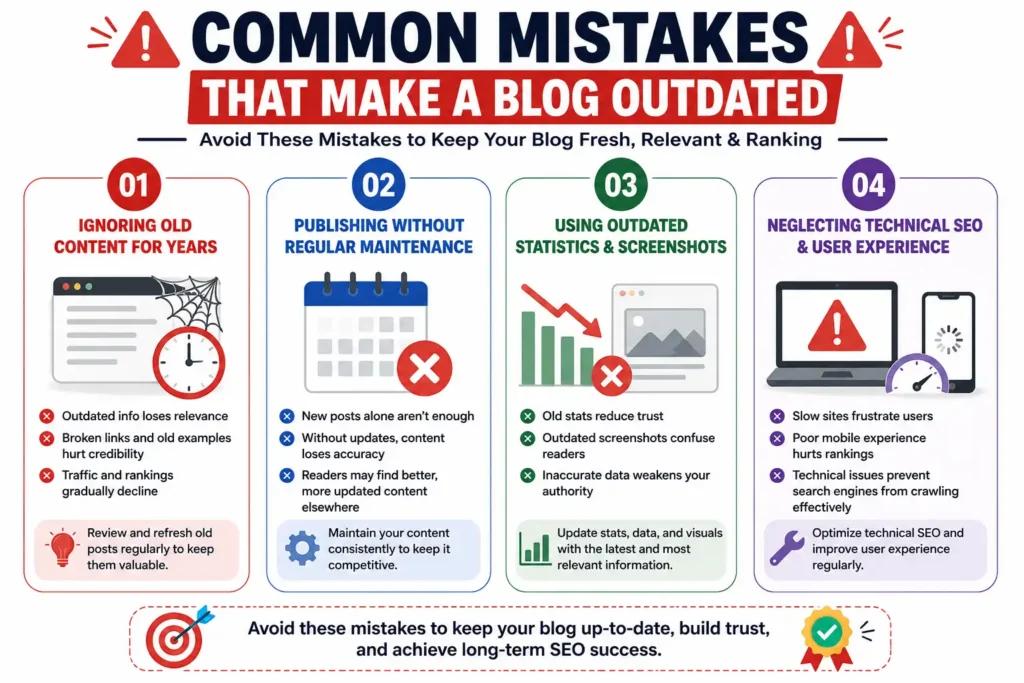
Many blogs lose traffic not because the content is poor, but because it is neglected over time. Search behavior, SEO best practices, and industry trends constantly evolve, making regular maintenance essential. Ignoring updates can reduce credibility, lower search rankings, and create a poor user experience. Identifying these common mistakes helps you protect your existing content investment while maintaining strong organic visibility. Avoiding these issues keeps your blog useful, trustworthy, and competitive in an increasingly crowded search landscape.
Ignoring Old Content for Years
Leaving articles untouched for several years often results in declining rankings and reduced traffic. Statistics become outdated, recommendations change, and broken links appear naturally over time. Schedule regular content audits to identify pages needing attention. Refreshing evergreen posts keeps them relevant and ensures readers continue receiving accurate, trustworthy information that reflects the latest industry developments.
Publishing Without Regular Maintenance
Many website owners focus only on publishing new articles while forgetting previously published content. Without ongoing maintenance, valuable posts slowly lose relevance and performance. Build a content maintenance schedule that includes updating links, correcting outdated information, improving formatting, and optimizing for changing search intent.
Using Outdated Statistics and Screenshots
Nothing reduces credibility faster than obsolete data or screenshots from outdated software versions. Readers expect current information they can trust when making decisions. Replace old statistics with figures from reputable organizations, update images that no longer match modern interfaces, and verify every external reference. Accurate information strengthens authority and improves your content’s overall trustworthiness.
Neglecting Technical SEO and User Experience
Strong content cannot fully succeed if technical problems frustrate users or prevent efficient crawling. Slow page speed, broken links, poor mobile usability, and confusing navigation all reduce engagement. Regular technical audits help identify these issues before they affect rankings. A fast, accessible, and user-friendly website supports both search engine visibility and a positive visitor experience.
Essential Tools to Keep Your Blog Updated Efficiently
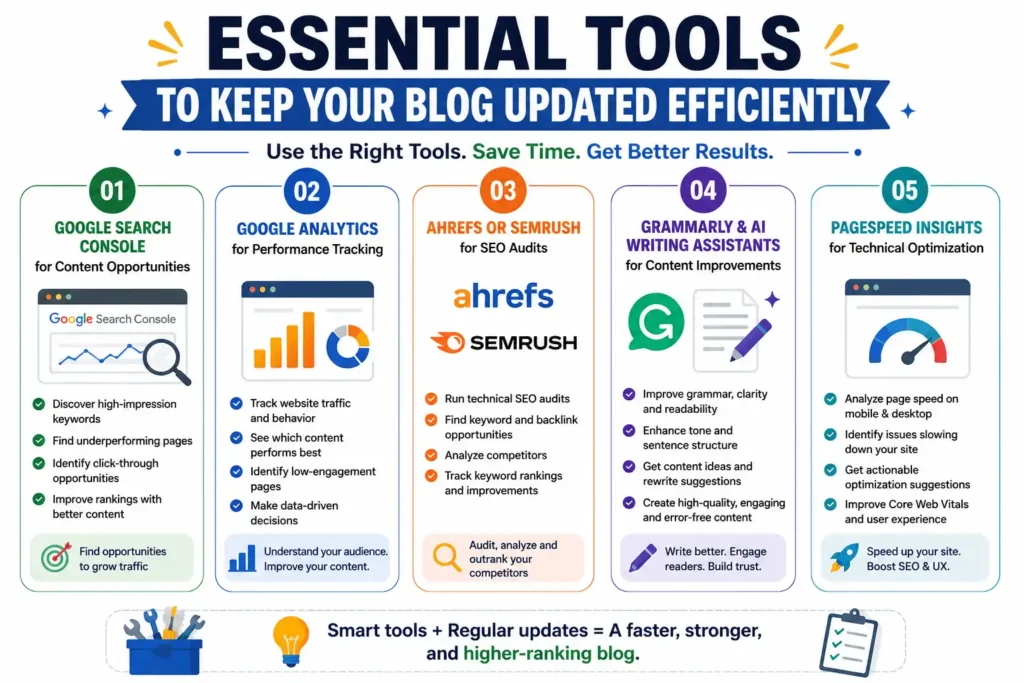
Updating a blog becomes much easier when you use the right tools. Modern SEO and analytics platforms help identify outdated content, discover keyword opportunities, monitor rankings, and improve overall performance. Instead of guessing what to update, rely on real data to prioritize changes with the greatest impact. Combining analytics, SEO auditing, writing assistance, and performance testing creates an efficient workflow that saves time while supporting sustainable organic growth. Investing in trusted tools also helps you make smarter, evidence-based content decisions.
Google Search Console for Content Opportunities
Google Search Console is one of the most valuable free SEO tools available. It shows which queries generate impressions, where pages rank, and which articles have declining performance. Use this data to update titles, improve content depth, target additional keywords, and increase click-through rates. Regularly reviewing Search Console helps uncover easy opportunities for traffic growth.
Google Analytics for Performance Tracking
Google Analytics provides valuable insights into how visitors interact with your content. Monitor engagement time, bounce rate, conversions, and traffic sources to understand what performs best. Identify pages with declining engagement and improve them through better content, stronger internal linking, or updated calls-to-action. Data-driven improvements consistently outperform decisions based on assumptions.
Ahrefs or Semrush for SEO Audits
Comprehensive SEO platforms like Ahrefs and Semrush help identify keyword gaps, backlink opportunities, broken links, technical issues, and competitor strategies. Regular site audits reveal problems before they affect rankings. These tools also track keyword performance over time, making it easier to measure the impact of your content updates and overall SEO strategy.
Grammarly and AI Writing Assistants for Content Improvements
Editing tools help maintain high writing quality while improving clarity, grammar, readability, and consistency. Grammarly catches language issues, while modern AI writing assistants help rewrite outdated sections, generate ideas, and improve content flow. Human review remains essential, but combining AI with careful editing produces more accurate, engaging, and reader-friendly articles.
PageSpeed Insights for Technical Optimization
Google PageSpeed Insights evaluates your website’s loading performance across desktop and mobile devices. It identifies issues such as oversized images, render-blocking resources, and slow server response times. Improving these technical factors enhances user experience and supports Core Web Vitals. Faster websites encourage longer visits, lower bounce rates, and stronger overall SEO performance.
Frequently Asked Questions?
How often should I update my blog?
There is no universal schedule because every website is different. As a general rule, review important evergreen articles every six to twelve months. Posts covering fast-changing topics such as technology, finance, health, or digital marketing may require more frequent updates. Monitor traffic, rankings, and industry changes to determine when content needs refreshing.
Is updating old posts are better than writing new posts?
Both strategies are valuable and should work together. Updating high-performing older content helps preserve and improve existing rankings, while publishing new articles expands your topical authority and attracts additional audiences. A balanced content strategy that refreshes evergreen posts while consistently creating new, high-quality content typically delivers the strongest long-term SEO results.
What parts of a blog post should be updated?
Focus on information that may have become outdated or incomplete. Refresh statistics, examples, screenshots, external links, internal links, keywords, headings, meta descriptions, and calls-to-action. You should also improve readability, answer newly popular search queries, and add fresh insights that increase the article’s overall value for readers and search engines.
Does Google rank updated content higher?
Google does not automatically reward content simply because it has been updated. However, meaningful improvements that make a page more accurate, comprehensive, and helpful can improve its ability to rank well. Updating content to better satisfy search intent, fix outdated information, and enhance user experience aligns with Google’s guidance for creating helpful, people-first content.
How do I know which blog posts need updating first?
Start by reviewing your analytics and SEO data. Prioritize pages with declining organic traffic, falling keyword rankings, high impressions but low click-through rates, or outdated information. Evergreen articles with strong backlink profiles are excellent candidates because updating them often produces faster SEO improvements than creating entirely new content.
Can updating old content increase website traffic?
Yes. Refreshing valuable content can improve keyword rankings, increase click-through rates, and attract more organic visitors when updates genuinely enhance the page. Many SEO professionals regularly see positive traffic growth after improving outdated articles, especially when they align the content with current search intent and add more comprehensive information.
What tools help keep a blog updated?
Several tools simplify content maintenance. Google Search Console identifies ranking opportunities, Google Analytics measures user behavior, Ahrefs and Semrush perform SEO audits, Grammarly improves writing quality, and Google PageSpeed Insights helps optimize technical performance. Using these tools together creates a data-driven workflow for maintaining a healthy, competitive blog.
Should I change the publish date after updating a blog post?
If you make substantial improvements such as adding new research, rewriting sections, updating examples, or expanding the content significantly, updating the publish or “last updated” date can be appropriate. However, avoid changing dates after making only minor edits, as transparency and accuracy help build trust with both readers and search engines.
Conclusion
Keeping your blog updated is one of the most effective ways to improve SEO, maintain credibility, and deliver lasting value to your audience. Regularly refreshing older articles, publishing high-quality content, optimizing for current search intent, improving user experience, and tracking performance all contribute to sustainable organic growth. Instead of viewing content as something you publish once and forget, treat every blog post as a long-term asset that deserves ongoing attention. With a consistent update strategy and the right tools, your blog can continue attracting readers, earning higher search rankings, and generating meaningful results for years to come.
📈 Build lasting online authority with True Linkers.
How to Choose a Website for Backlinks (SEO Guide)
Introduction
Backlinks remain one of the strongest signals search engines use to evaluate a website’s authority, but not every backlink helps your rankings. A single link from a trusted, relevant website can deliver more SEO value than dozens of links from low-quality sources. That is why choosing the right website is just as important as earning the backlink itself. This guide explains how to identify websites that strengthen your SEO, improve topical authority, and support long-term organic growth. You’ll also learn which metrics matter most before investing time in link-building opportunities.
Why Choosing the Quality Website for Backlinks Is Important
Search engines evaluate backlinks based on quality, relevance, and trust rather than quantity alone. According to Google, links are one of the many ranking factors that help its systems understand the credibility of web pages. A backlink from a respected website in your niche can improve search visibility, referral traffic, and brand authority, while links from spammy or irrelevant sites may provide little value or even create SEO risks. Selecting high-quality backlink sources ensures every link contributes to sustainable rankings and a stronger online reputation over time.
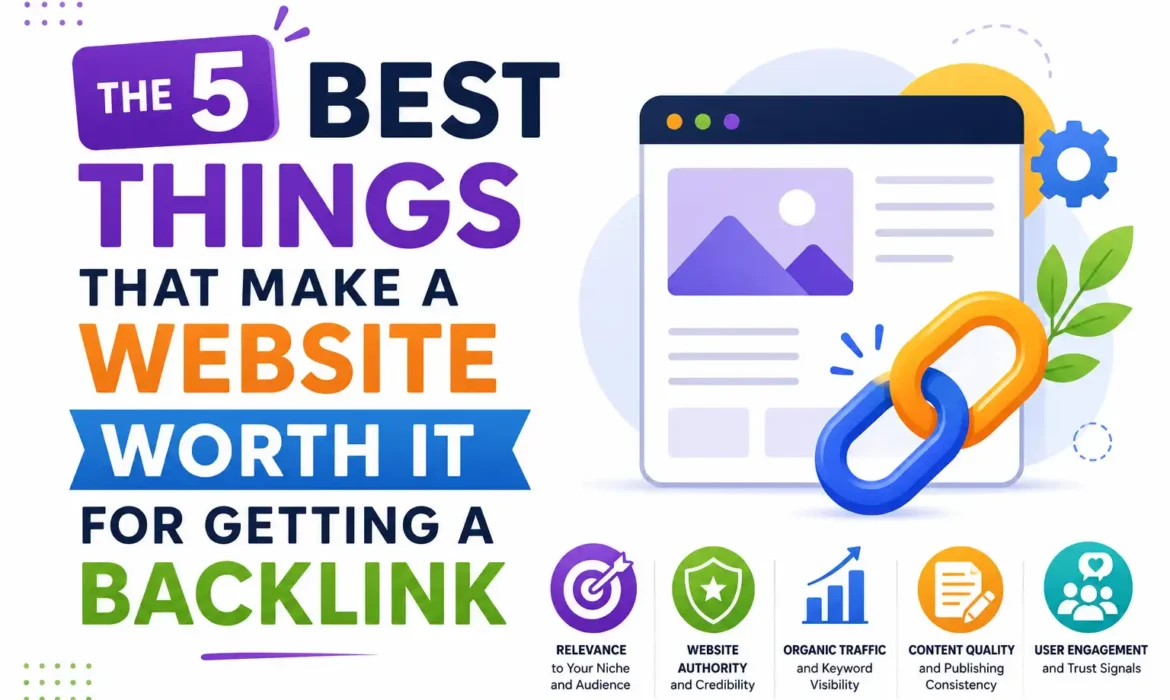
5 Best Things That Make a Website Worth It for Getting a Backlink
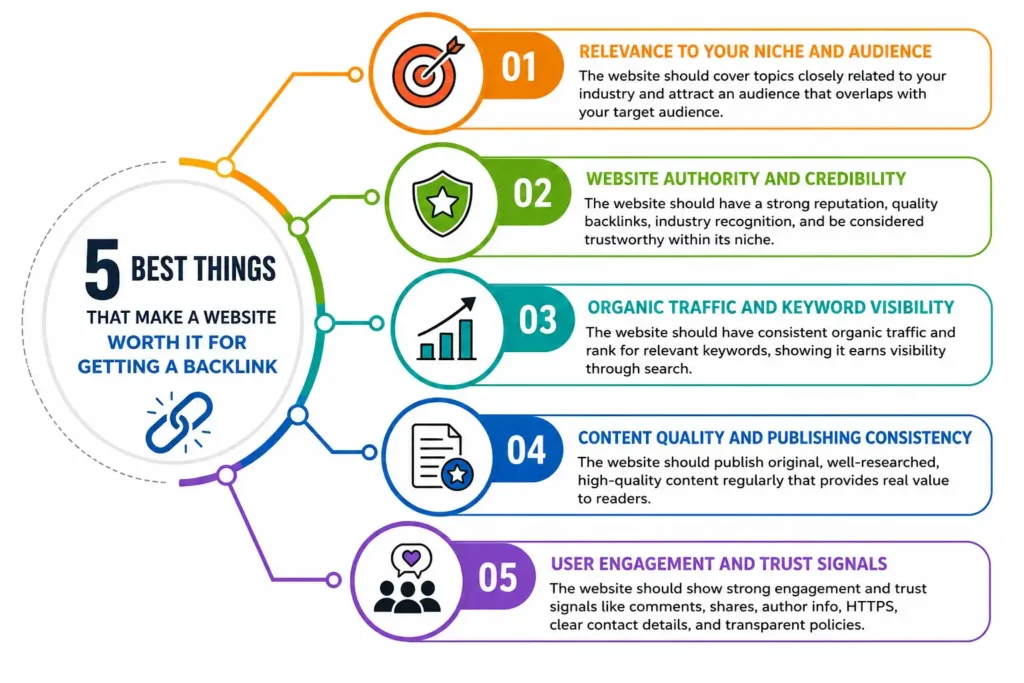
Relevance to Your Niche and Audience
A backlink delivers the greatest SEO value when it comes from a website covering topics closely related to your industry. Search engines use contextual relevance to understand why a link exists. If your audience naturally overlaps with the referring site’s readers, the backlink is more likely to improve rankings while driving qualified referral traffic that converts into real visitors or customers.
Website Authority and Credibility
Authority reflects how trustworthy and respected a website appears within its niche. Look beyond a single metric by evaluating brand reputation, editorial quality, backlinks, and industry recognition. Websites consistently referenced by reputable publications and businesses generally pass stronger trust signals, making backlinks from them more valuable for long-term SEO performance and brand credibility.
Organic Traffic and Keyword Visibility
Healthy organic traffic shows that a website earns visibility through search rather than relying solely on paid promotion. Analyze whether traffic has remained stable over time and whether the site ranks for relevant keywords. Consistent keyword visibility indicates search engines trust the content, increasing the likelihood that backlinks from the website will provide meaningful SEO benefits.
Content Quality and Publishing Consistency
High-quality websites publish original, well-researched content that solves readers’ problems instead of chasing keywords alone. Review recent articles for accuracy, readability, and depth. A consistent publishing schedule also signals an active website that continues attracting users and search engine attention, helping your backlinks remain valuable over the long term.
User Engagement and Trust Signals
Strong engagement often indicates that readers find the website helpful and credible. Look for meaningful comments, active social sharing, author profiles, secure HTTPS connections, clear contact information, and transparent editorial policies. These trust signals suggest the website serves real users instead of existing only to sell backlinks, making it a safer and more valuable linking opportunity.
Essential Metrics to Check Before Choosing a Website
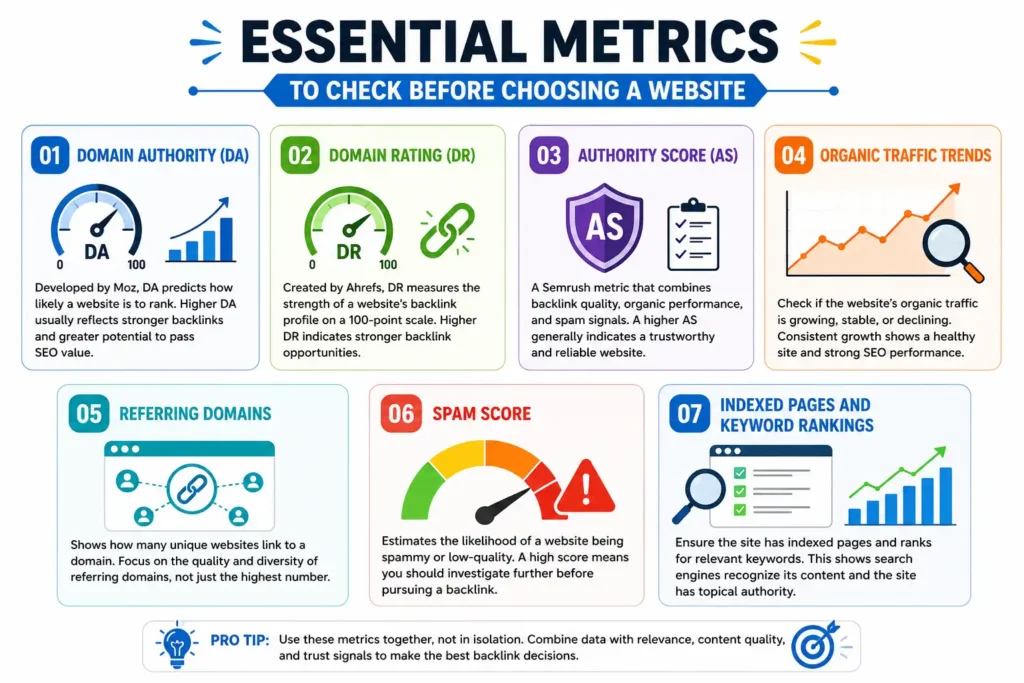
Domain Authority (DA)
Domain Authority, developed by Moz, predicts how likely a website is to rank compared with other domains. Although Google does not use DA as a ranking factor, it remains a useful comparative metric. Higher DA often reflects stronger backlinks, established authority, and greater potential to pass SEO value through quality backlinks.
Domain Rating (DR)
DR focuses primarily on backlink quality and quantity rather than content performance. Comparing DR among competing websites helps identify stronger backlink opportunities, especially when combined with traffic, relevance, and editorial quality.
Authority Score (AS)
Authority Score is Semrush’s proprietary metric that combines backlink quality, organic search performance, and spam indicators into a single evaluation. A healthy Authority Score generally suggests a trustworthy website with sustainable SEO performance. Use it alongside other metrics instead of relying on it as your only decision-making factor.
Organic Traffic Trends
Reviewing traffic trends reveals whether a website is growing, stable, or losing search visibility. Consistent organic growth usually reflects quality content and strong SEO practices, while sudden traffic declines may indicate algorithm penalties or reduced relevance. Always analyze historical traffic instead of relying on a single monthly traffic estimate.
Referring Domains
The number of referring domains shows how many unique websites link to a domain. A diverse backlink profile from reputable websites is generally more valuable than thousands of links from only a few sources. Focus on the quality and diversity of referring domains rather than simply pursuing the highest number.
Spam Score
Spam Score estimates the likelihood that a website demonstrates characteristics commonly associated with low-quality or manipulative websites. A high score does not automatically mean a website is harmful, but it should encourage further investigation. Review the site’s content, backlinks, and overall credibility before considering any backlink opportunity.
Indexed Pages and Keyword Rankings
A healthy website should have important pages indexed and rank for relevant search queries. Checking indexed pages confirms that search engines recognize the site’s content, while keyword rankings demonstrate topical authority and visibility. Strong indexing combined with consistent keyword performance usually indicates a trustworthy website worth considering for backlinks.
How to Evaluate Website Quality Like an SEO Expert
Experienced SEO professionals never judge a website by a single metric like Domain Authority or Domain Rating. Instead, they evaluate multiple quality signals to determine whether a backlink will provide long-term SEO value. This includes analyzing backlinks, content quality, topical relevance, user experience, and overall website credibility. Google’s ranking systems reward websites that demonstrate expertise, trust, and helpful content. By following a structured evaluation process, you can avoid risky backlink sources and focus your efforts on websites that genuinely strengthen your search visibility and authority.
Analyze the Site’s Backlink Profile
A strong backlink profile contains links from reputable, relevant websites rather than thousands of low-quality domains. Use tools like Ahrefs or Semrush to review referring domains, anchor text diversity, and link growth trends. Natural backlinks from trusted publications, industry blogs, and authoritative resources indicate that the website has earned credibility instead of manipulating search rankings.
Review Content Originality and Depth
Quality websites publish original content that provides real value instead of rewriting existing articles or relying entirely on AI-generated text. Review several recent posts for research, practical insights, updated information, and clear structure. Comprehensive content demonstrates expertise, improves user satisfaction, and increases the likelihood that search engines trust the website.
Check Topical Authority
Topical authority measures how comprehensively a website covers a specific subject. Instead of publishing random topics, authoritative websites build clusters of related content around their niche. Search engines better understand their expertise, making backlinks from these sites more valuable. Consistent coverage also attracts readers genuinely interested in your industry.
Examine Internal Linking Structure
A well-planned internal linking strategy helps search engines understand website architecture while guiding users to relevant content. Quality websites naturally connect related articles, important service pages, and cornerstone resources. Logical internal links improve crawling, distribute page authority efficiently, and demonstrate that the website follows sound SEO best practices.
Evaluate User Experience and Page Speed
User experience directly affects visitor engagement and website credibility. Check whether pages load quickly, display correctly on mobile devices, and offer simple navigation. Google’s Core Web Vitals emphasize performance, responsiveness, and visual stability. A fast, user-friendly website typically retains visitors longer and signals higher overall quality.
Identify Signs of a Real Business or Brand
Trustworthy websites usually represent genuine businesses, organizations, or established brands. Look for detailed About pages, author profiles, contact information, social media presence, privacy policies, and customer testimonials. These trust signals show accountability and transparency, making backlinks from the website significantly safer and more valuable.
Red Flags That Indicate a Low-Quality Backlink Website
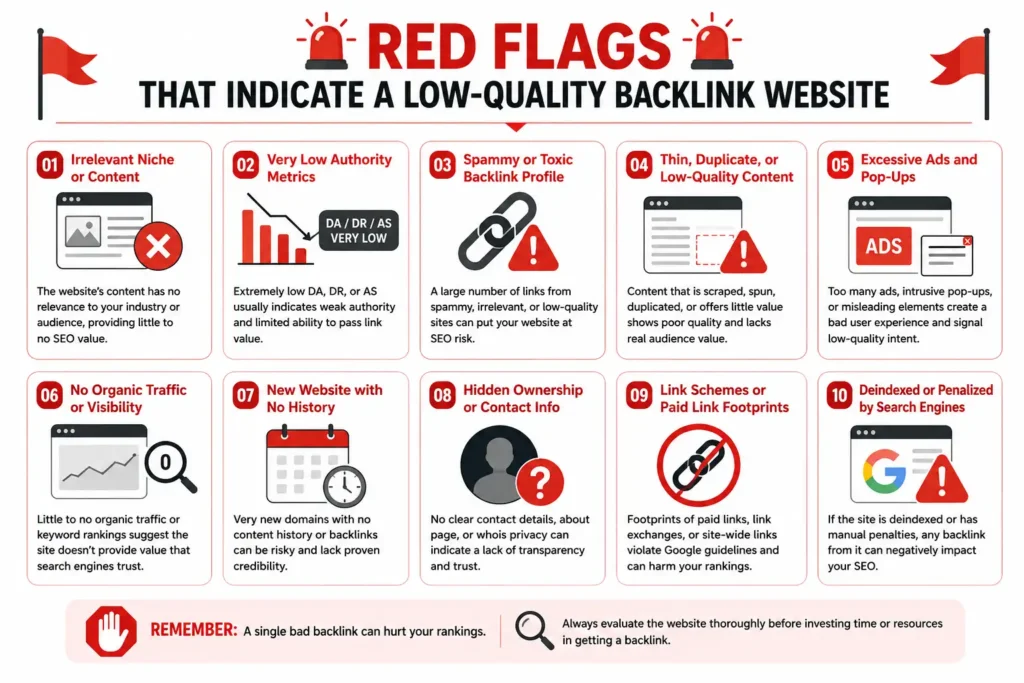
High Spam Score
A high Spam Score suggests that a website shares characteristics commonly associated with low-quality domains. While the score alone should not determine your decision, it deserves further investigation. Review the website’s backlinks, content quality, and reputation before building links, especially if several warning signs appear together.
Thin, AI-Generated, or Duplicate Content
Websites filled with shallow articles, copied content, or poorly edited AI-generated text rarely provide lasting SEO value. Search engines prioritize helpful, original content created for users. If most pages lack depth, unique insights, or factual accuracy, the website is unlikely to be a worthwhile backlink source.
Excessive Outbound Links
Pages overloaded with external links often indicate that the website exists primarily for link selling. When every article links to dozens of unrelated websites, the value passed through each backlink decreases. Editorially placed links within useful content are generally far more beneficial than excessive promotional linking.
Irrelevant Niche or Mixed-Topic Websites
A website covering unrelated topics such as finance, health, travel, gambling, and technology without clear expertise often lacks topical focus. Search engines value contextual relevance, so backlinks from mixed-topic websites usually carry less authority. Prioritize websites that consistently publish content related to your industry and audience.
Paid Link Farms and Private Blog Networks (PBNs)
Link farms and Private Blog Networks are built primarily to manipulate search rankings by exchanging or selling backlinks. These networks usually share weak content, unnatural linking patterns, and limited user engagement. Google’s spam policies target manipulative link schemes, making backlinks from these websites a significant SEO risk.
Sudden Traffic Drops or Deindexed Pages
A sharp decline in organic traffic may indicate algorithm updates, manual penalties, or technical issues affecting search visibility. Likewise, pages disappearing from Google’s index suggest serious quality concerns. Always review historical traffic trends and indexed pages before investing time or resources into acquiring backlinks from any website.
Best Types of Websites to Get High-Quality Backlinks From
The strongest backlinks come from websites that have earned trust, authority, and relevance within their industries. Instead of chasing links from any available source, focus on websites that naturally align with your business and audience. Quality backlinks from reputable publications, organizations, and industry resources improve both search visibility and brand credibility. The following website categories consistently provide some of the most valuable backlink opportunities when earned through helpful content, genuine relationships, and editorial standards.
Industry Blogs
Industry blogs attract readers already interested in your niche, making them excellent backlink opportunities. Guest posts, expert contributions, and resource mentions on respected blogs provide contextual relevance while introducing your brand to a targeted audience. These backlinks often deliver both SEO value and qualified referral traffic.
News and Media Websites
Backlinks from reputable news and media websites strengthen authority because they typically follow strict editorial guidelines. Earning these links through original research, expert commentary, case studies, or company announcements can significantly improve brand credibility while exposing your business to a much broader audience.
Business Directories
Reputable business directories help search engines verify your company’s legitimacy and improve online visibility. Focus on trusted, industry-specific directories rather than submitting your website everywhere. Accurate business information, consistent contact details, and relevant listings contribute more value than hundreds of low-quality directory submissions.
Resource Pages
Resource pages are designed to recommend valuable tools, guides, and educational content. If your website offers genuinely useful information, these pages can provide highly relevant editorial backlinks. Because they exist to help users, resource page links often carry strong contextual value and long-term SEO benefits.
Educational (.edu) Websites
Educational websites often publish research, learning resources, scholarship pages, and industry references trusted by students and professionals. While the “.edu” extension alone does not increase ranking power, relevant backlinks from authoritative educational websites can significantly strengthen your website’s credibility and topical trust.
Government (.gov) Websites
Government websites are generally trusted because they publish official information and maintain high editorial standards. Although earning backlinks from these websites is challenging, they can be valuable when your business contributes public resources, research, educational materials, or community-focused initiatives relevant to government organizations.
SaaS and Business Partner Websites
Partnerships with software providers, vendors, and complementary businesses often create natural backlink opportunities. Customer success stories, integration pages, testimonials, and partner directories generate highly relevant editorial links. These backlinks not only improve SEO but also strengthen business relationships and referral opportunities within your industry.
Community and Association Websites
Professional associations, nonprofit organizations, local business groups, and industry communities often maintain trusted member directories and educational resources. Participating in these communities can earn valuable backlinks while increasing brand visibility. Because these websites serve real audiences, their backlinks frequently provide both SEO authority and meaningful referral traffic.
5 Tools to Analyze a Website Before Building a Backlink
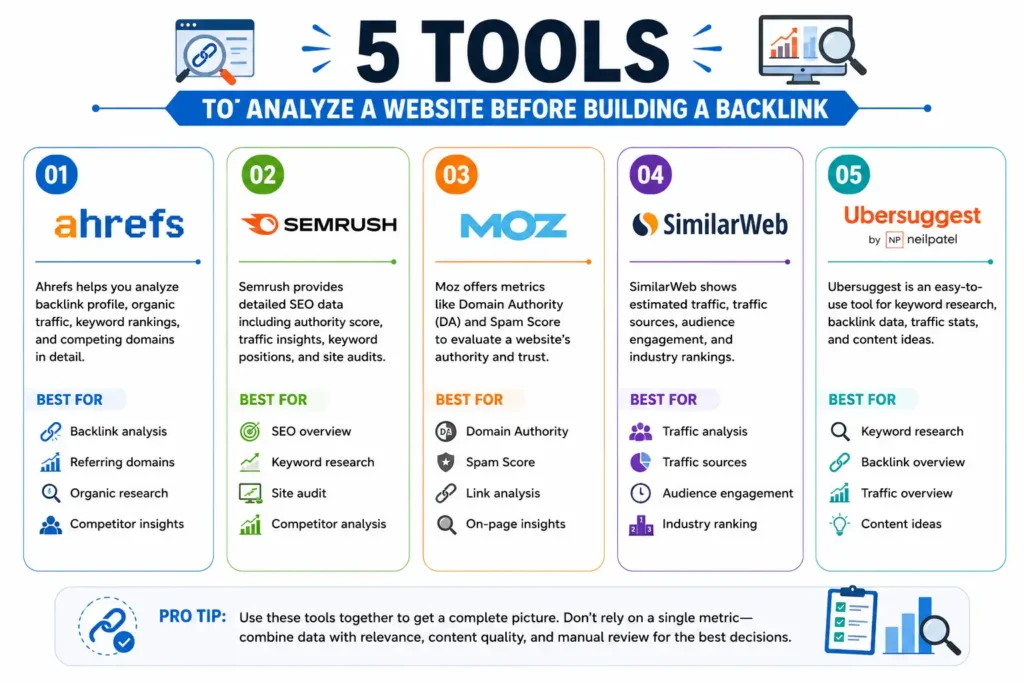
Ahrefs
Ahrefs is one of the most trusted SEO platforms for backlink analysis. It provides Domain Rating (DR), referring domains, anchor text distribution, organic keywords, and historical link growth. Its extensive backlink database helps identify authoritative websites, analyze competitors, and discover high-quality link-building opportunities with confidence.
Semrush
Semrush offers a complete SEO toolkit that combines Authority Score, backlink analysis, keyword rankings, traffic estimates, and competitive research. It also identifies toxic backlinks and monitors domain performance over time. Using multiple reports together helps you evaluate whether a website is genuinely worth targeting for backlinks.
Moz
Moz is well known for introducing Domain Authority (DA), one of the industry’s most recognized comparative metrics. Besides DA, it offers Spam Score, keyword tracking, and backlink analysis. While Google does not use DA directly, Moz remains a valuable tool for comparing website authority across similar competitors.
Majestic
Majestic specializes in backlink intelligence through proprietary metrics such as Trust Flow and Citation Flow. Trust Flow measures the quality of backlinks, while Citation Flow evaluates link quantity. Reviewing both metrics together helps determine whether a website has earned natural authority or relies on excessive low-quality links.
Google Search Operators
Google Search operators help you discover backlink opportunities without paid tools. Commands like site:, intitle:, inurl:, and quotation marks allow you to find guest posting websites, resource pages, niche blogs, and competitor mentions. They remain a simple yet highly effective method for backlink prospecting.
Google Search Console (For Your Own Website)
Google Search Console provides first-party data about your website’s backlinks, indexed pages, search performance, and referring domains. Although it does not analyze competitor websites, it helps monitor your existing backlink profile, identify top linking pages, and detect indexing issues that may affect SEO performance.
Similarweb
Similarweb estimates website traffic, audience demographics, engagement metrics, and traffic sources. It helps verify whether visitors come from organic search, direct traffic, social media, or paid campaigns. Combining Similarweb data with traditional SEO metrics creates a more complete evaluation before pursuing backlink opportunities.
Step-by-Step Process to Choose the Best Website for Backlinks
Define Your Backlink Goals
Start by identifying what you want each backlink to accomplish. Your objective may be improving keyword rankings, increasing referral traffic, strengthening topical authority, or building brand awareness. Clear goals help you prioritize the right websites instead of pursuing backlinks that provide little strategic value.
Find Relevant Websites in Your Niche
Search for websites that regularly publish content related to your products, services, or industry. Relevant websites provide stronger contextual signals and attract audiences genuinely interested in your expertise. Industry blogs, resource pages, associations, and trusted publications usually offer the most valuable backlink opportunities.
Evaluate SEO Metrics
Review important SEO metrics such as Domain Authority, Domain Rating, Authority Score, referring domains, organic keywords, and Spam Score. These indicators help compare websites objectively. However, always combine multiple metrics rather than relying on a single number to determine backlink quality.
Analyze Traffic Quality
Traffic volume alone does not guarantee a valuable backlink. Review where visitors come from, whether organic traffic remains stable, and if the website ranks for relevant keywords. Consistent search visibility and engaged visitors indicate healthier websites than domains relying mainly on paid or temporary traffic sources.
Review Backlink Opportunities
Examine how the website typically links to external resources. Editorial mentions, guest posts, resource pages, expert interviews, and partnership pages often provide stronger backlinks than promotional directories. Choose opportunities where your content naturally fits the audience and adds genuine value.
Check Editorial Standards
High-quality websites maintain clear editorial guidelines and publish accurate, well-researched content. Review grammar, formatting, fact-checking, author profiles, and publishing consistency. Strong editorial standards indicate that backlinks are earned based on content quality rather than simply purchased or exchanged.
Prioritize Quality Over Quantity
A handful of authoritative, relevant backlinks usually outperform hundreds of low-quality links. Google’s ranking systems reward natural link profiles built through valuable content and genuine recommendations. Focus on earning backlinks that strengthen your website’s authority rather than simply increasing your backlink count.
Frequently Asked Questions
What Is a Good Domain Authority for Backlinks?
There is no universal minimum Domain Authority for valuable backlinks. Generally, websites with a DA above 40 are considered relatively strong, but relevance and content quality matter far more than the score itself. A highly relevant website with moderate authority can provide greater SEO value than an unrelated website with a much higher DA.
Is Website Traffic More Important Than DA or DR?
Neither metric should be evaluated alone. Healthy organic traffic indicates that a website performs well in search results, while DA and DR estimate authority based on backlinks. The best backlink opportunities combine relevant content, consistent traffic, strong authority, and genuine user engagement.
How Can I Identify a Spammy Website?
Review multiple warning signs instead of relying only on Spam Score. Thin content, excessive outbound links, poor design, irrelevant topics, unnatural backlink profiles, and sudden traffic declines often indicate a low-quality website. Using tools like Ahrefs, Semrush, and Moz makes identifying these risks much easier.
Are Paid Backlinks Worth It?
Paying for backlinks solely to manipulate search rankings violates Google’s Search Essentials. While sponsored partnerships and advertisements are legitimate when properly disclosed, buying editorial backlinks for SEO carries significant risk. Focus on earning backlinks through valuable content, digital PR, and genuine industry relationships instead.
How Many Backlinks Should a Website Have?
There is no ideal number of backlinks because every industry and website is different. A smaller website with relevant, high-quality backlinks can outperform competitors with thousands of low-value links. Building a natural backlink profile should always take priority over reaching a specific backlink count.
Which Tools Are Best for Checking Backlink Quality?
The most reliable backlink analysis tools include Ahrefs, Semrush, Moz, Majestic, Google Search Console, and Similarweb. Each platform measures different aspects of website quality, so combining insights from several tools provides the most accurate evaluation before pursuing backlink opportunities.
Can a Backlink From a Low-Authority Website Still Be Valuable?
Yes. A backlink from a low-authority website can still provide value if the website is highly relevant, publishes quality content, attracts genuine visitors, and serves your target audience. Relevance, editorial placement, and trust often outweigh raw authority metrics in many situations.
How Often Should I Evaluate Backlink Sources?
Review backlink sources regularly because website quality can change over time. Conducting a backlink audit every three to six months helps identify declining websites, spam risks, and new opportunities. Frequent monitoring also ensures your backlink profile remains healthy and aligned with current SEO best practices.
Conclusion
Building high-quality backlinks starts with choosing the right websites, not simply collecting more links. By evaluating relevance, authority, content quality, organic traffic, backlink profiles, and trust signals, you can identify websites that genuinely strengthen your SEO strategy. Using trusted tools such as Ahrefs, Semrush, Moz, Majestic, Google Search Console, and Similarweb makes the evaluation process more accurate and data-driven. Remember that long-term SEO success comes from earning natural, editorial backlinks from credible websites that provide real value to users. When quality becomes your priority, every backlink contributes to stronger rankings, greater brand authority, and sustainable organic growth.
🚀 Grow your website with smarter SEO strategies. Follow True Linkers.