
How to Start a Marketing Agency in 2026 | Best Guide
Starting a marketing agency in 2026 is one of the most practical ways to build a profitable online business. As companies continue investing in digital growth, they need experts who can generate leads, improve search rankings, manage paid advertising, and create engaging content. At the same time, artificial intelligence has made agency operations faster and more efficient, allowing even small teams to compete with larger firms.
According to industry research from Statista, global digital advertising spending is expected to continue growing throughout 2026, while businesses are increasingly outsourcing specialized marketing tasks instead of hiring large in-house teams. This creates significant opportunities for freelancers, consultants, and entrepreneurs who want to launch their own agencies.
This step-by-step guide explains everything beginners need to know, from choosing the right niche and creating a business plan to setting up a legal business, building a professional brand, and pricing services confidently.
Choose Your Marketing Agency Niche and Services
One of the biggest mistakes new agency owners make is trying to serve everyone. Instead, choose a niche where you can become an expert and build authority faster. You might specialize in SEO, PPC advertising, content marketing, email marketing, social media management, or AI automation. You can also focus on industries such as healthcare, real estate, SaaS, law firms, or ecommerce. A specialized agency communicates a clearer value proposition, attracts better-qualified leads, and often commands higher pricing. Once your niche is defined, create service packages that solve measurable business problems rather than simply offering marketing tasks.
Build a Business Plan for Your Marketing Agency
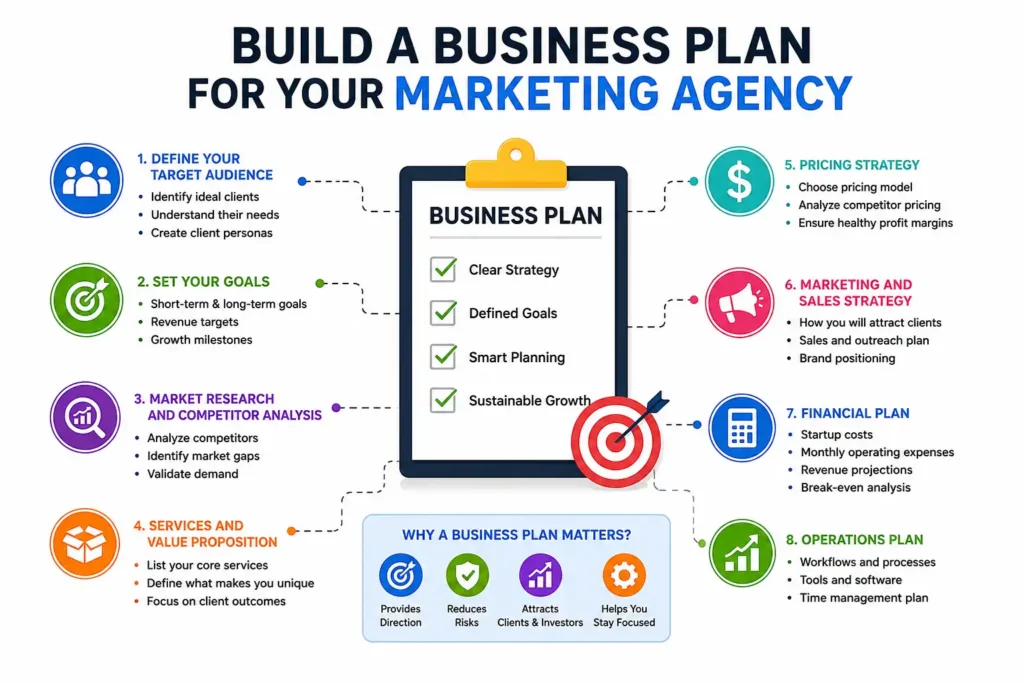
A well-structured business plan gives your agency direction and improves long-term decision-making. Define your target audience, competitive advantages, pricing strategy, revenue goals, marketing channels, and projected expenses before launching. Include realistic financial estimates for software subscriptions, advertising, taxes, and operational costs. Research competitors to identify market gaps you can fill with unique positioning.
According to the U.S. Small Business Administration, businesses that plan carefully are generally better prepared for growth and unexpected challenges. Treat your business plan as a living document that evolves alongside your agency instead of a one-time exercise.
Register Your Marketing Agency and Set Up the Business
Registering your marketing agency establishes credibility and protects your business legally. Choose the appropriate business structure based on your country’s regulations, such as an LLC, sole proprietorship, or corporation. Obtain required tax registrations, business licenses, and banking accounts before signing clients.
Separate personal and business finances to simplify accounting and tax reporting. Use professional accounting software to track income, expenses, and invoices accurately from day one. Having legally compliant contracts, clear payment terms, and privacy policies also helps prevent disputes while creating trust with clients and business partners.
📌 Don’t Miss These Articles: How to Keep Your Blog Updated for Better SEO
Create Your Brand, Website, and Online Presence
Your agency’s online presence acts as your strongest sales representative, so invest in building a professional brand from the beginning. Develop a memorable business name, consistent logo, color palette, and messaging that reflect your niche. Your website should clearly explain your services, showcase case studies, display testimonials, and include strong calls to action.
Optimize every page for SEO using relevant keywords and a fast-loading design. Maintain active profiles on LinkedIn and other platforms where your target audience spends time. Publishing educational content consistently helps establish credibility, improve search visibility, and attract qualified inbound leads.
Decide Your Pricing Model and Agency Packages
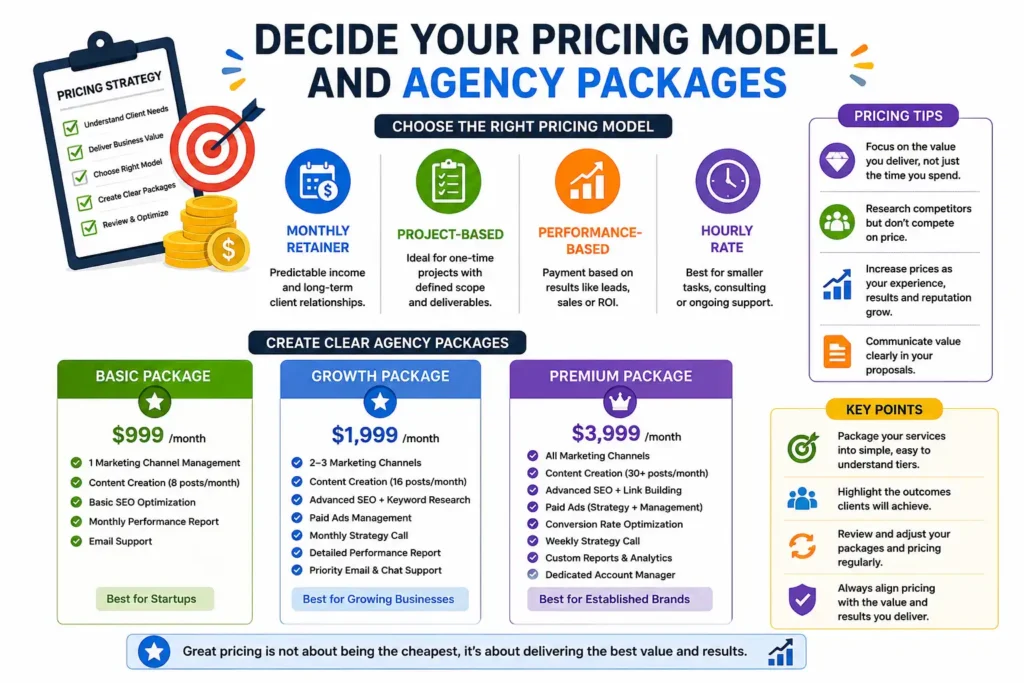
Choosing the right pricing model directly impacts your profitability and client relationships. Most successful agencies use monthly retainers because they provide predictable recurring revenue and encourage long-term partnerships. Project-based pricing works well for website development or one-time SEO audits, while performance-based pricing can suit lead generation campaigns with measurable outcomes.
Package your services into clear tiers instead of offering endless custom quotes. Explain the business value clients receive rather than focusing only on deliverables. Review your pricing regularly as your expertise, reputation, and client results continue to grow over time.
Get Your First Clients and Build a Strong Reputation
Getting your first clients is often the hardest part of starting a marketing agency, but it becomes easier with a focused strategy. Begin by leveraging your existing network, LinkedIn connections, local businesses, and freelance platforms. Offer free or discounted pilot projects to build case studies and collect testimonials. Publish valuable content that demonstrates your expertise and answers common marketing questions.
According to HubSpot’s State of Marketing research, businesses increasingly prefer agencies that showcase measurable results and industry knowledge. Deliver outstanding customer service, communicate consistently, and exceed expectations to earn referrals that fuel long-term agency growth.
📌 Don’t Miss These Articles: How to Choose a Website for Backlinks (SEO Guide)
Build the Right Team and Scale Your Agency
As your client base grows, building the right team becomes essential for maintaining quality and increasing profitability. Start by outsourcing specialized tasks such as graphic design, copywriting, web development, or video editing before hiring full-time employees. Create documented workflows and standard operating procedures to ensure consistent service delivery.
Invest in training and encourage collaboration through modern communication platforms. Successful agencies focus on improving systems rather than simply adding more people. By automating repetitive work, delegating responsibilities, and tracking key performance indicators, you can scale efficiently while maintaining exceptional client satisfaction and healthy profit margins.
Best AI Tools and Marketing Software for Agencies in 2026
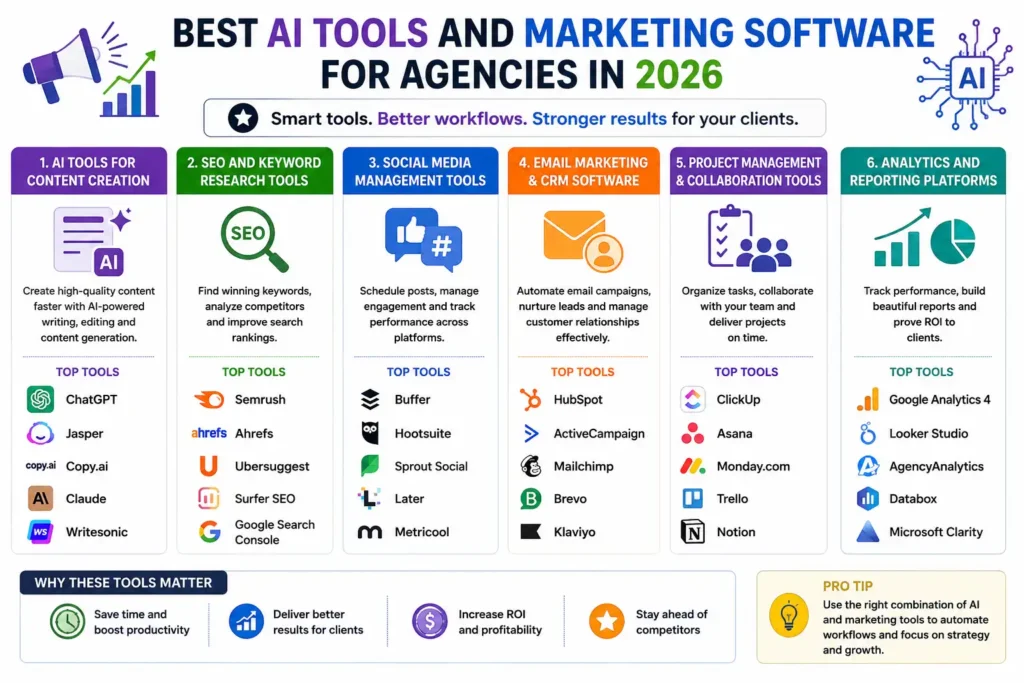
Modern marketing agencies rely heavily on artificial intelligence and automation to improve productivity, reduce operational costs, and deliver better client results. The right software can streamline content creation, keyword research, project management, reporting, customer communication, and campaign optimization.
According to McKinsey research, organizations adopting AI effectively are achieving significant productivity improvements across knowledge-based work. Instead of using dozens of disconnected platforms, choose tools that integrate well with your workflow. Below are some of the most valuable AI-powered marketing tools every agency should consider using in 2026.
AI Tools for Content Creation
AI-powered content tools help agencies create high-quality blogs, ad copy, email campaigns, landing pages, and social media posts much faster than traditional methods. Popular platforms like ChatGPT, Claude, Jasper, and Copy.ai assist with brainstorming, writing, editing, and content optimization while maintaining brand consistency. Human editing remains essential for originality, fact-checking, and maintaining a unique voice. Agencies that combine AI efficiency with professional expertise consistently produce better results.
SEO and Keyword Research Tools
Strong SEO campaigns begin with reliable keyword and competitor research. Tools such as Ahrefs, Semrush, Google Search Console, Surfer SEO, and Keyword Insights help agencies discover search opportunities, analyze backlinks, monitor rankings, and optimize content. These platforms also identify technical SEO issues and content gaps that competitors have not addressed. Using accurate search data enables agencies to create strategies based on real user demand instead of assumptions.
Social Media Management Tools
Managing multiple client accounts manually wastes valuable time. Platforms like Buffer, Hootsuite, Sprout Social, Metricool, and Later simplify scheduling, content planning, engagement tracking, and performance reporting across major social networks. Many now include AI-powered caption generation, hashtag suggestions, and optimal posting time recommendations. Centralizing social media management allows agencies to improve consistency while saving hours every week.
Email Marketing and CRM Software
Email marketing remains one of the highest ROI digital marketing channels. According to Litmus research, email marketing continues delivering exceptional returns for many businesses when executed strategically. Platforms like HubSpot, ActiveCampaign, Mailchimp, Brevo, and Klaviyo help agencies automate campaigns, segment audiences, nurture leads, and manage customer relationships. Combining CRM data with marketing automation creates highly personalized customer experiences that improve conversions and long-term retention.
Project Management and Collaboration Tools
Efficient project management keeps agency operations organized and clients satisfied. Platforms such as ClickUp, Asana, Monday.com, Trello, and Notion allow teams to assign tasks, monitor deadlines, share files, and collaborate in real time. Integrating communication tools like Slack further improves productivity and reduces unnecessary meetings. Clear workflows minimize mistakes, improve accountability, and help agencies deliver projects on schedule.
Analytics and Reporting Platforms
Clients expect transparent reporting that demonstrates measurable business impact. Google Analytics 4, Looker Studio, AgencyAnalytics, Databox, and Microsoft Clarity help agencies measure website performance, understand visitor behavior, monitor marketing campaigns, and track conversion data through detailed analytics and reporting. Automated dashboards reduce manual reporting while helping agencies explain ROI clearly. Data-driven reporting also supports better strategic decisions and strengthens long-term client relationships by highlighting continuous performance improvements.
Don’t Make These Mistakes When Starting a Marketing Agency
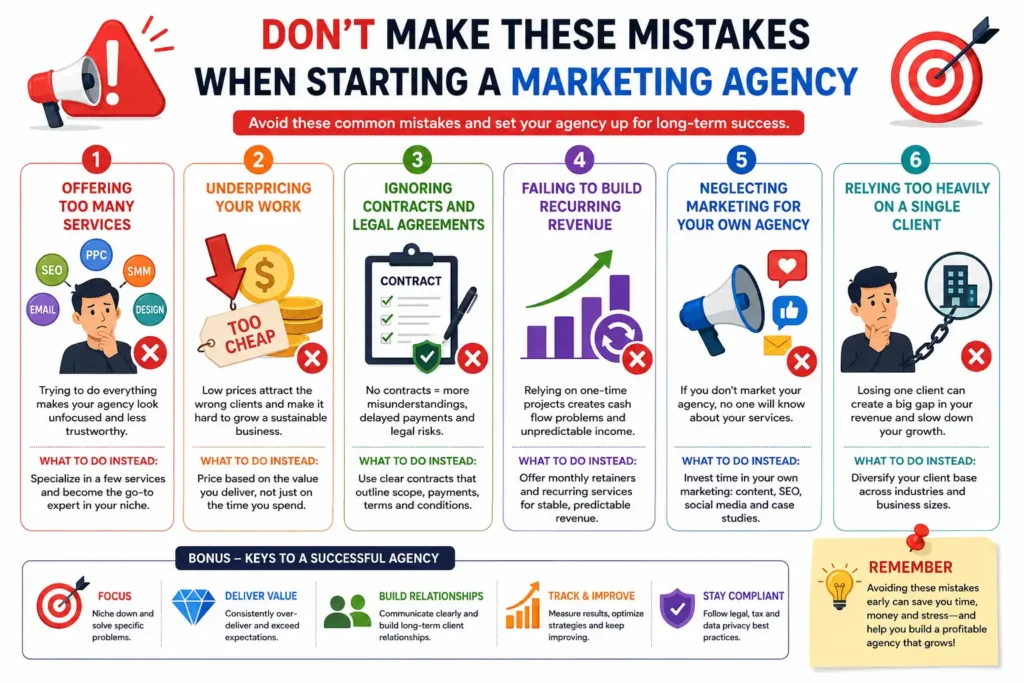
Many marketing agencies fail because of avoidable mistakes rather than a lack of demand. Poor positioning, weak financial planning, inconsistent service quality, and ineffective client management can limit long-term growth. Learning from common agency failures helps you avoid costly setbacks and build a stronger business foundation. Focus on sustainable systems instead of chasing quick wins. By maintaining realistic pricing, specializing in your expertise, and delivering consistent results, you can establish a profitable agency that earns client trust and grows steadily in an increasingly competitive digital marketplace.
Offering Too Many Services
Trying to provide every marketing service often confuses potential clients and weakens your positioning. Instead, specialize in a few high-value services where your team delivers exceptional results. A focused agency builds authority faster, simplifies operations, and attracts better-qualified leads looking for specific expertise rather than general marketing assistance.
Underpricing Your Work
Many beginners charge extremely low prices just to win clients, but this often attracts difficult customers and reduces profitability. Price your services based on the value you deliver instead of competing solely on cost. Sustainable pricing allows you to invest in better tools, talented professionals, and long-term business growth.
Ignoring Contracts and Legal Agreements
Never begin client work without a professionally written contract. Clearly define project scope, payment schedules, ownership rights, revision limits, confidentiality, and termination clauses. Strong agreements protect both parties, reduce misunderstandings, and create a professional client experience that strengthens trust from the beginning of every engagement.
Failing to Build Recurring Revenue
Depending only on one-time projects creates inconsistent cash flow and limits long-term growth. Instead, develop monthly retainers for SEO, content marketing, social media management, or paid advertising. Recurring revenue provides financial stability, improves client retention, and allows you to forecast future business performance more accurately.
Neglecting Marketing for Your Own Agency
Many agency owners spend all their time marketing clients while ignoring their own business. Consistently publish helpful content, improve your website’s SEO, share case studies, and stay active on LinkedIn. Demonstrating your own marketing success builds credibility and generates qualified inbound leads without relying entirely on referrals.
Relying Too Heavily on a Single Client
Depending on one large client creates unnecessary business risk. If that client leaves, your revenue can drop dramatically overnight. Diversify your client portfolio across multiple industries and business sizes to create stable income. A balanced client base protects your agency during economic changes and unexpected contract cancellations.
Frequently Asked Questions
How much money do I need to start a marketing agency?
You can start a marketing agency with as little as $500 to $3,000, depending on your business model and the services you offer. Your initial expenses typically include a domain name, website hosting, branding, business registration, essential software, and marketing tools. If you work remotely and use AI-powered platforms, startup costs remain relatively low. Many successful agency owners begin as solo freelancers before reinvesting profits into hiring team members and expanding their operations.
Can I start a marketing agency with no experience?
Yes, but you should first develop practical marketing skills before accepting paying clients. Learn through online courses, certifications, personal projects, internships, or freelance work. Build a portfolio by helping local businesses or nonprofit organizations achieve measurable results. Certifications from Google, HubSpot, and Meta can strengthen your credibility. The more real-world experience and case studies you have, the easier it becomes to attract clients and establish trust in a competitive marketplace.
Which marketing services are most profitable in 2026?
In 2026, some of the highest-profit marketing services include SEO, paid advertising (PPC), AI automation consulting, conversion rate optimization, content marketing, email marketing, social media advertising, and marketing strategy consulting. These services often generate recurring monthly revenue while delivering measurable business results. Agencies specializing in high-demand industries such as SaaS, healthcare, finance, and ecommerce can often charge premium rates because clients place significant value on proven expertise and measurable growth.
How do marketing agencies get their first clients?
Most agencies secure their first clients through personal networks, LinkedIn outreach, referrals, local business communities, and freelance marketplaces. Publishing valuable content, sharing case studies, and offering free consultations also help build credibility. Cold email campaigns and strategic partnerships with web developers or business consultants can generate qualified leads. Providing outstanding service to early clients often results in testimonials and referrals, creating a steady pipeline of new business opportunities.
How long does it take to become profitable?
The timeline depends on your pricing, expenses, marketing strategy, and client acquisition efforts. Many solo agency owners become profitable within three to twelve months if they consistently attract recurring clients and manage expenses carefully. Agencies focused on monthly retainers generally achieve more predictable revenue than those relying solely on one-time projects. Consistency, strong client relationships, and efficient operations are the biggest factors influencing long-term profitability.
Should I start alone or with a team?
Starting alone is often the smartest option because it keeps costs low and allows you to understand every part of your business. As your workload increases, outsource specialized tasks such as design, development, or video editing before hiring full-time employees. This flexible approach reduces financial risk while allowing your agency to grow naturally. Build a permanent team only when consistent client demand supports sustainable long-term expansion.
Is starting a marketing agency still worth it in 2026?
Yes. Demand for digital marketing continues to increase as businesses compete online and adopt AI-driven strategies. Companies still need experienced professionals to manage SEO, advertising, content creation, analytics, and customer acquisition. While competition has grown, agencies that specialize in a specific niche, deliver measurable results, and leverage AI effectively continue to build profitable businesses. Success depends more on expertise, positioning, and execution than simply entering the market early.
What skills are essential to run a successful marketing agency?
A successful agency owner needs a combination of marketing expertise and business management skills. Core abilities include SEO, paid advertising, content marketing, analytics, communication, sales, client relationship management, project management, and financial planning. Leadership, problem-solving, and adaptability are equally important as marketing trends continue evolving. Learning how to use AI tools effectively is now becoming a competitive advantage for agencies serving modern businesses.
Can I run a marketing agency remotely?
Absolutely. Modern cloud-based software allows agencies to operate entirely online while serving clients worldwide. Video conferencing, project management platforms, file-sharing systems, and digital payment solutions make remote collaboration simple and efficient. Many successful agencies have fully distributed teams working across different countries and time zones. Operating remotely also reduces overhead costs while giving you access to a larger talent pool and broader client opportunities.
Which AI tools should every new marketing agency use?
Every new marketing agency should consider using AI tools that improve productivity without sacrificing quality. Popular options include ChatGPT and Claude for content creation, Semrush or Ahrefs for SEO research, Canva AI for design, HubSpot AI for CRM and marketing automation, ClickUp AI for project management, and Google Analytics 4 for performance tracking. Choosing integrated tools helps streamline workflows, save time, and deliver better client outcomes with fewer manual tasks.
Conclusion
Starting a marketing agency in 2026 offers tremendous opportunities for entrepreneurs willing to develop valuable skills and build a client-focused business. Success doesn’t require a large office or a massive investment. Instead, it depends on choosing the right niche, creating clear service packages, using modern AI tools, delivering measurable results, and building long-term client relationships.
Focus on continuous learning, maintain high service standards, and adapt to changing marketing trends. With patience, consistency, and a growth mindset, your marketing agency can evolve into a profitable and scalable business that serves clients around the world.
💡 Learn what really works in modern SEO. Follow True Linkers.